

A new interview revealed why Jeff Kaplan left Activision Blizzard.
Former vice president of Blizzard Entertainment and Overwatch game designer Jeff Kaplan has revealed why he left the company. He went into Overwatch League (OWL), player-versus-player (PvE), and what he’s working on now.
Why Jeff Kaplan left Overwatch
In an interview with Lex Fridman, Kaplan shared that the OWL became a major derail for the development of Overwatch 2. According to him, executives heavily marketed the esports league, which attracted billionaire investors. This meant ambitious promises as the Overwatch team then had to support commitments tied to a streaming rights deal with Twitch, camera systems, and team skins.
“We had a coalition on the team that was really wanting Overwatch 2 built instead of the live events, and then the executive pressure became monumental,” Kaplan said. “And what would have been correct was to do more world events — like keep it going. But the major derail was Overwatch League.”
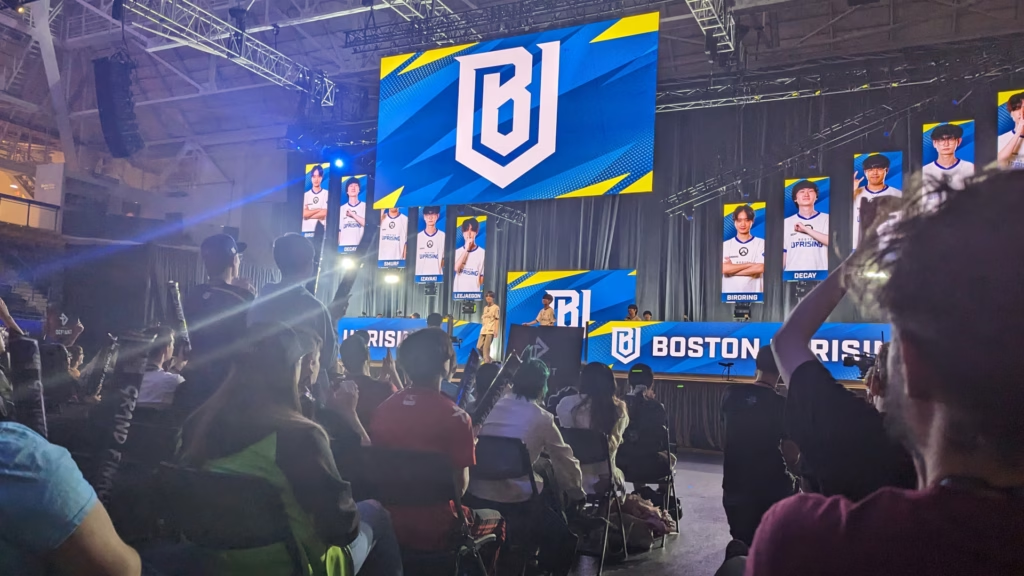
He continued, adding that there was a heavy focus on making money quickly. The league championed talented players and dedicated staff, however, it ultimately became a fragile system driven by financial goals. He recalled that the original business model relied on global in-person events, ticket sales, and merchandise, but those plans quickly fell apart due to the logistical challenges of international teams. The growing financial pressure then pushed the team to focus on monetization and extracting value from the live game. At the same time, the team also faced pressure to ship Overwatch 2 while losing resources that once supported events plus new heroes and maps.
“The merch was good, but it wasn’t gonna be making NFL-level money — whatever insanity anybody thought that was gonna be,” Kaplan said. “So everybody quickly defaulted back to, ‘Hey, didn’t Overwatch make like $500 million just in the live game last year? What can we sell and what can you give us?’ That pressure comes onto the team. And then [add] the pressure to ship Overwatch 2 and all [the] care and love that we had for the live game and the live service — let’s just make events and new heroes and new maps — we’re losing all these resources.”
What happened to Overwatch PvE?
Kaplan shared his thoughts on the player-versus-environment (PvE) experience as well. The released version was not the same game the team originally planned and announced. Rather, the original vision included a major PvE component while still prioritizing PvP for the existing player base.
“I think everybody would have loved to have played it,” he said, referring to PvE. “And there’s a misconception online that all I cared about was PvE and I didn’t care about PvP. All of the Overwatch 2 PvP maps were something that I said to the team over and over — ‘We have a PvP audience. If we get anything right, it has to be the PvP. We would be lucky to welcome these PvE players, but that’s not guaranteed.’ So it was never a PvE-only focus.”
He added that where he once had strong control over the direction of Overwatch during its early success, the OWL and the growing scope of Overwatch 2 eventually became burdens that contributed to his departure.
Money versus the love of one’s craft
What ultimately broke Kaplan was when the then-CFO told him that Overwatch had to hit revenue targets or he would be responsible for laying off a significant number of people. That was a surreal moment, and such a demand conflicted with his love for creating games.
“What sort of ultimately broke me in my Blizzard career was I got called into the CFO’s offic, and he sat me down and […] he gives me a date, which at the time was 2020 and was going to slip to 2021, but at the time it was 2020. And he said, ‘Overwatch has to make [redacted] in 2020. And then every year after that, it needs a recurring revenue of [redacted]” And then he said to me, ‘If it doesn’t do [redacted] dollars, we’re gonna lay off a thousand people. And that’s gonna be on you,'” Kaplan recalled. “And that was just the biggest f**k you moment I had in my career. It felt surreal to be in that condition.”
He continued, “I think there’s a message to creative people out there and people who make stuff. We’re generally so focused on the love of the craft that we get lost in it and we love doing it. And we’re not cutthroat. And we don’t have that kind of ambition. We have a different kind of ambition. But there’s this whole world — especially as soon as you’re lucky enough to have success — that are very cutthroat and very ambitious. And for whatever reason, we keep giving ourselves to them. And we need to stop giving ourselves.”
To Kaplan, Blizzard Entertainment succeeded through passionate developers and not executives. For example, a CFO wasn’t needed to make World of Warcraft.
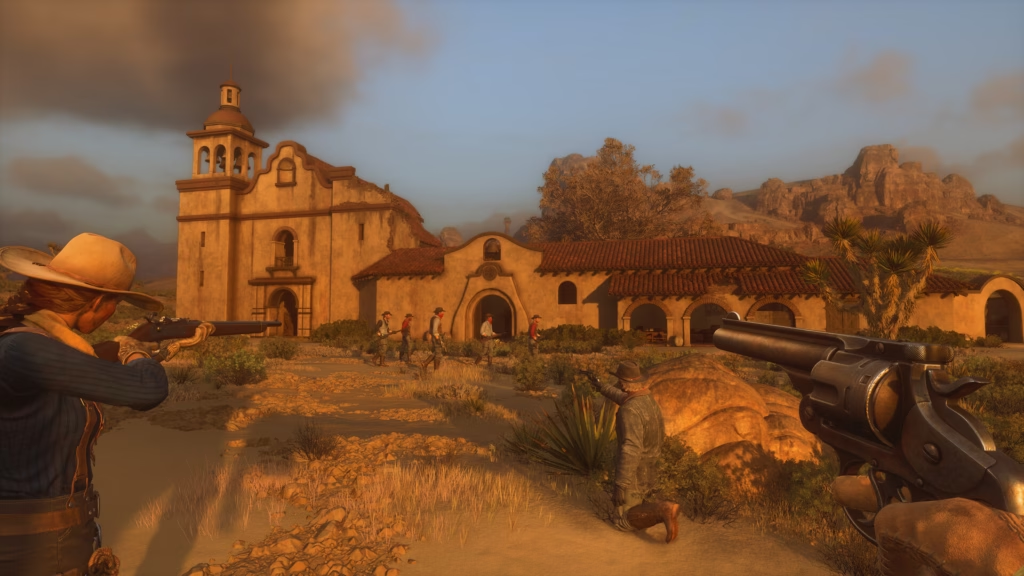
The Legend of California game
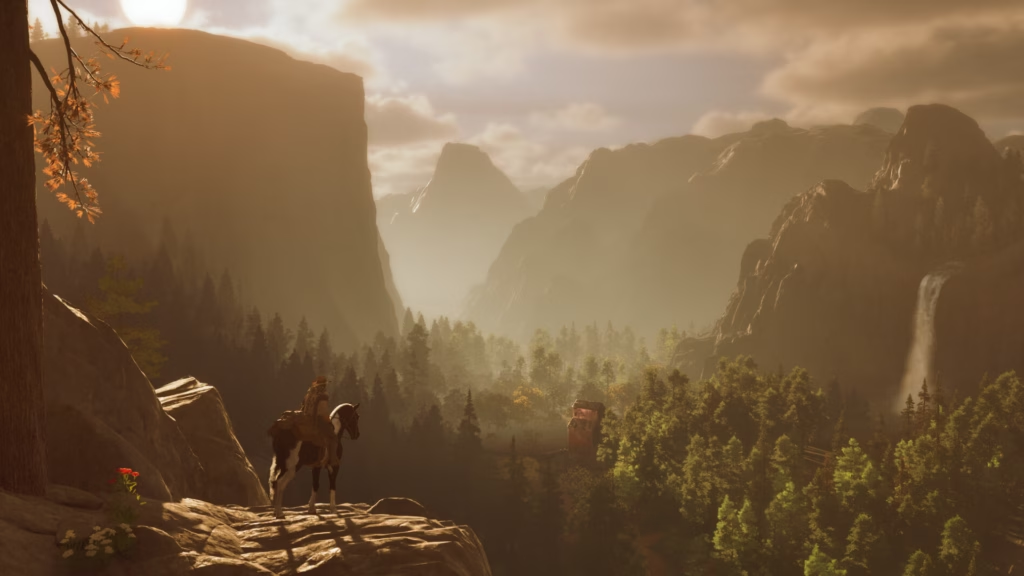
In terms of what he’s working on now, Kaplan revealed that his new company is called Kintsugiyama. The name holds special meaning to him as it represents the Japanese art of repairing broken pottery with gold. He said the game that he’s developing is The Legend of California as well, which is an open-world title set on a mythical island version of California during the gold rush.
“The theme of the game is very weird,” he explained. “We’re not trying to make a historical game. There’s no historical accuracy to this. In fact, the island, when first discovered, is uninhabited. That’s already not true, as we know. There were lots of people in California. It’s an island, which we know is not true. We want it to feel authentic to that time period because we think that time period is cool. Prospectors, cowboys — it’s a really fun thing for us to explore — all of those themes. People in mines.We wanna build mines. We just wanna create a world that you can live in. I love creating worlds. Everything that I’ve worked on before — from World of Warcraft to Overwatch — it’s always been, ‘How do you create this place for players to escape to?'”
That’s all for now. The full podcast can be accessed via Spotify, YouTube, Fridman’s website, and more.