

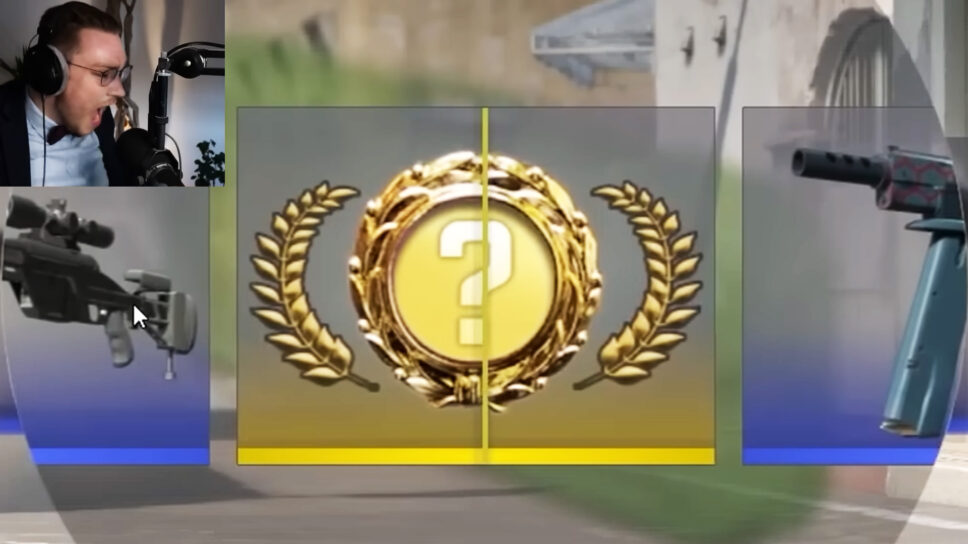
NY AG Letitia James is suing Valve for alleged promotion of "illegal gambling" features. The lawsuit even has an Ohnepixel cameo alongside alleged misinformation.
The New York State Attorney General, Letitia James, is suing Valve Corporation for “illegally promoting gambling through video games,” and named Dota 2, Counter-Strike 2, and Team Fortress 2 in the suit. Here’s the rundown on the lawsuit and how the gaming community reacted.
Editor’s Note: This is a report on a pending lawsuit. The allegations within the press release and lawsuit made publicly available by the New York Office of the Attorney General have not been proven in court and no legal judgment has been reached as of the time of writing.
AG James says Valve games “resemble a slot machine” in lawsuit
A press release dated Feb. 25, 2026, from the Office of the New York State Attorney General revealed that NY AG James is suing Valve following an investigation.
An investigation by the Office of the Attorney General (OAG) found that Valve’s video games, including Counter-Strike 2, Team Fortress 2, and Dota 2, enable gambling by enticing users to pay for the chance to win a rare virtual item of significant monetary value. In Valve’s most popular game, the process resembles a slot machine, with an animated spinning wheel that eventually rests on a selected item.
New York State Office of the Attorney General
This excerpt most likely refers to Counter-Strike 2 and its weapon cases. You’ve most likely seen it yourself and hoped for a gold, whether by playing the game and opening one first-hand, or through popular content creators, like Mark “Ohnepixel” Zimmermann. As a matter of fact, he actually makes an appearance in the lawsuit — more on this in an upcoming section.
According to AG James’ lawsuit, Valve has allegedly made billions of dollars through its games’ cosmetics market while not providing any in-game functionality for any of them. AG James seeks to “permanently stop Valve from continuing to promote illegal gambling in its games,” on top of fines for violating New York laws and disgorgement of all “ill-gotten gains”.
“Illegal gambling can be harmful and lead to serious addiction problems, especially for our young people. Valve has made billions of dollars by letting children and adults alike illegally gamble for the chance to win valuable virtual prizes. These features are addictive, harmful, and illegal, and my office is suing to stop Valve’s illegal conduct and protect New Yorkers.”
New York Attorney General Letitia James
Moreover, the suit also seeks a permanent injunction against Valve’s “gambling-like” features. The Prayer for Relief section also suggests a fine of three times the amount that the corporation gained, pursuant to a section in the Penal Law.
Counter-Strike 2, Dota 2, and Team Fortress 2 in the NY lawsuit
These three games were named in the suit, with a particular focus on CS2.
All three games are free-to-play, and the lawsuit alleges that Valve’s monetization of these titles “comes from in-game randomized cosmetics”. The lawsuit particularly attacks the real-life value of these items on the Steam Community Market and on third-party markets.
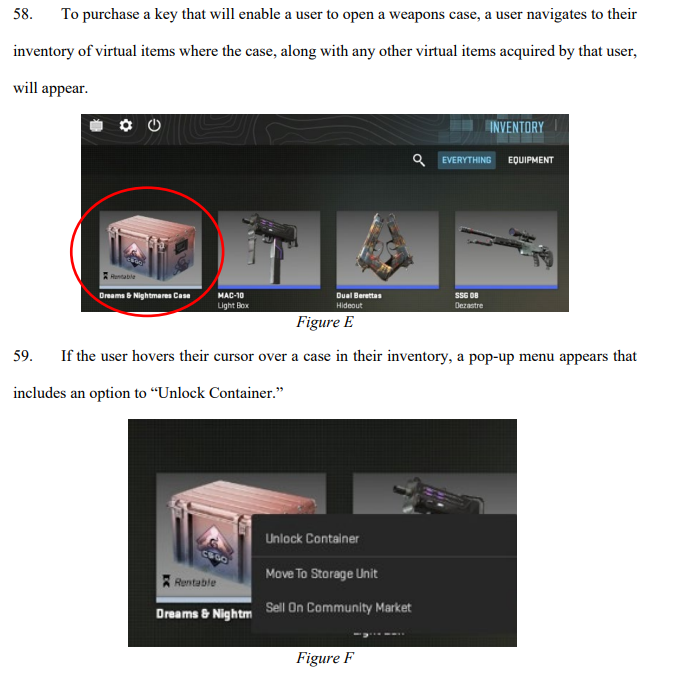
It references studies that relate loot boxes and problem gambling, and how, according to the American Psychiatric Association, ‘gambling disorder has been shown to carry the highest suicide risk out of any other substance use or addictive disorder.’ (§ 132, p. 39)
It also highlights that the risks are heightened for children and adolescents, and that the exposure to loot box concepts at these early ages makes them more susceptible to problem gambling. It is worth noting that all three of these games are rated Mature (17+) by the ESRB and even 18+ in some regions.
In particular, the lawsuit referenced a 2017 feature by ESPN that tells the story of a kid who began playing Counter-Strike: Global Offensive while he was in sixth grade.
Community reacts to Valve lawsuit, potential misleading contexts
The original X post by the official @NewYorkStateAG account received mostly negative responses from gamers. The general consensus is how come Valve is being singled out, while other game publishers and developers have more predatory features built into their games.
Another section of the press release that garnered the ire of gamers is one pertaining to gun violence in video games.
In addition, although this case is about illegal gambling, it is important to note that Valve’s promotion of games that glorify violence and guns helps fuel the dangerous epidemic of gun violence, particularly among young gamers who can become numbed to grave violence before their brains are fully developed.
New York State Office of the Attorney General
Eagle-eyed gamers also found potential discrepancies within the lawsuit itself. In Section 65 and Figure J, shown below, the suit discusses the similarity between CS2 cases and slot machines and the “near miss” feature.
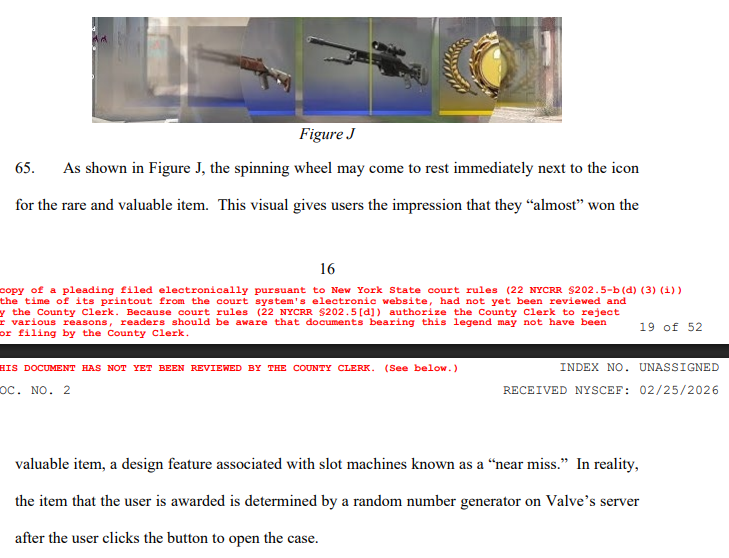
The section reads how the “spinning wheel may come to rest immediately next to the icon for the rare and valuable item,” in this case, the gold.
Community members pointed out that the described feature, colloquially known as a “gold bait,” has been removed in CS2. However, no official documentation from Valve suggests the removal of this feature.
Figure J is an in-game screenshot with the pointer hovering over the blue gun skin.

A closer look at Figure J, particularly its top-left corner, reveals an artifact that does not belong in the vanilla CS2 client. This is because, as gamers have discovered, it is actually a screenshot from an Ohnepixel stream and video posted seven months ago.
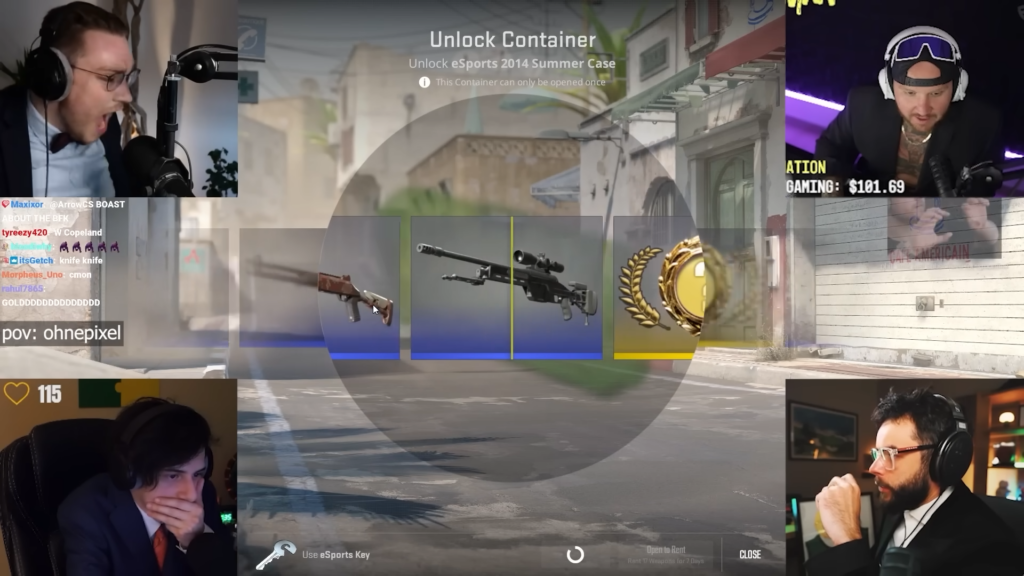
In 5:54 of the video linked below, you can see the exact same screengrab. In this case, it did stop on the gold, granting him a Case Hardened M9 Bayonet knife. This item averages about US$450 in the Steam Community Market according to third-party aggregators.
The link between video games, particularly esports, and betting has been growing stronger in recent times. Many online casinos now support betting for esports matches, and esports betting sites have become more accepted and have gained increasing visibility and importance within the scene.
Regardless of the eventual outcome of the OAG and Valve lawsuit, the protection and well-being of the youth remain important. Parental supervision, combined with a thorough understanding of video games and in-game features, is necessary to create a safe space for minors online.