

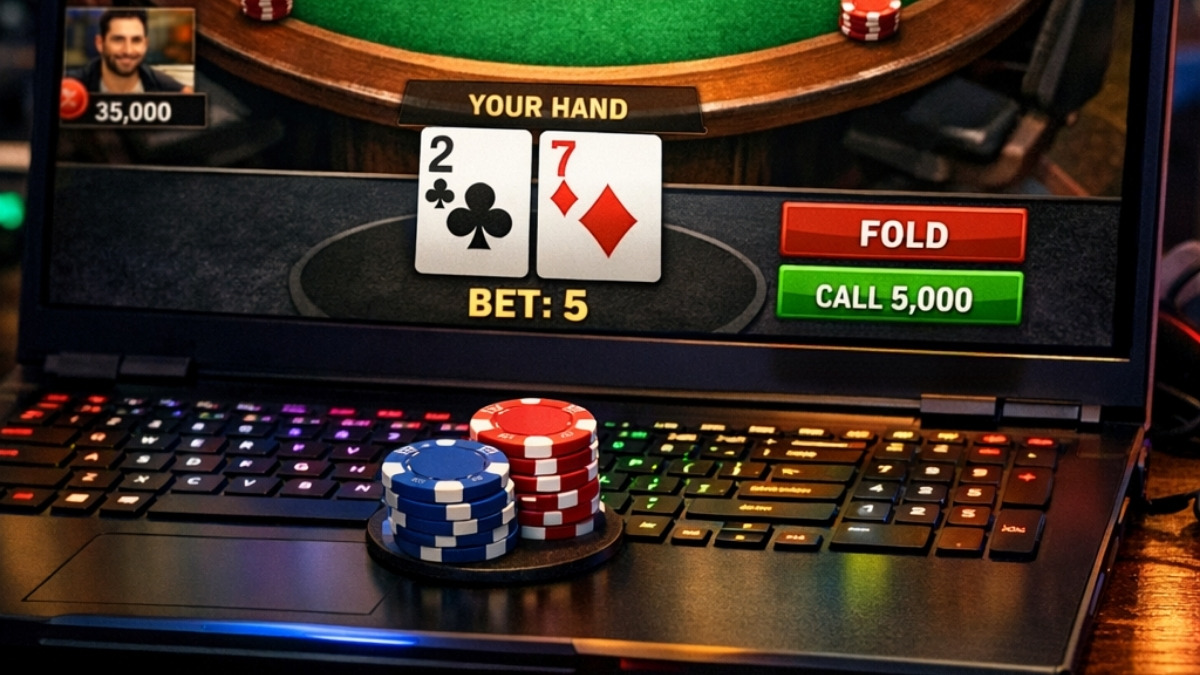
In Texas Hold’em, most players call 7-2 offsuit the worst hand because it has poor connectivity, no flush potential, and weak pair value.
If “worst” is defined strictly as the lowest heads-up win rate versus a random hand, an enumerated preflop table of all 169 starting-hand types puts 3-2 offsuit at the bottom, with 7-2 offsuit just above it.
What Is the Worst Hand in Poker?
“Worst poker hand” has two practical meanings in real money poker. Many players use it to describe the least playable starting hand (commonly 7-2 offsuit), while others mean the hand with the lowest heads-up win rate versus a random hand (3-2 offsuit in enumerated rankings). Stating the definition upfront keeps the rest of the math and comparisons consistent.
- Worst starting hand in poker (preflop strength): the hand that performs worst against typical ranges; 7-2 offsuit sits at the bottom in most common rankings.
- Worst possible poker hand (at showdown): the weakest final result category is a high-card hand. Illustrative runout (no flush possible): Board 9♣ 7♦ 5♥ 4♠ 2♠, hole cards 8♦ 3♥.
- Bad hand of cards in context: a hand that creates expensive second-best outcomes, like weak pairs with poor kickers against an opponent’s stronger top pair.
A quick math anchor helps frame how often you’ll see any exact starting hand: Hold’em has 1,326 distinct two-card combinations, so one specific combo shows up 12/1,326 = 0.905% of the time.
A better way to define the worst starting hand in poker is heads-up win rate versus a random hand. Based on poker calculations by Can I Win, in an enumerated heads-up table of all 169 starting-hand types, 7-2 offsuit (72o) shows 31.71% win and 5.74% tie, which is 34.58% equity when ties are split (31.71 + 5.74/2).
“Win% vs random” is a clean way to rank starting hands, but real decisions still depend on position and opponent ranges, which is why 7-2 offsuit can be called “worst” for playability even when 3-2 offsuit is lowest by raw win rate.
One reason 7-2 offsuit gets labeled “worst” in real tables is equity realization, not raw win rate. Low offsuit hands convert a smaller share of their theoretical equity into showdowns, especially out of position, because they lack draws that justify multi-street pressure or profitable bluffs.
Worst Possible Poker Hand: Why 7-2 Offsuit Gets the Label
7-2 offsuit sits at the bottom because it performs poorly in the spots that shape preflop value. The ranks are low and widely spaced, which limits straight paths to very specific runouts. Pairing either card rarely creates a hand that can stand pressure, since a paired 7 or 2 often runs into a stronger kicker from an opponent holding an ace, king, or even a middle card.
Incentives in poker can also nudge players into defending or bluffing with hands like 7-2 offsuit, but the underlying preflop math does not change.
The offsuit factor compounds the issue. Without a shared suit, flush draws are off the table, so the hand relies almost entirely on pairing up or catching a narrow straight. Those outcomes arrive infrequently, and when they do, they tend to build small pots or expensive second-best results.
That deal frequency is normal for offsuit non-pairs; the difference is that 7-2 offsuit offers fewer strong improvement paths when the flop lands.
Bottom 10 Worst Texas Hold’em Hands by Heads-Up Win Rate (vs Random Hand)
If “worst hand in Texas Hold’em” means lowest heads-up win rate versus a random hand, 7-2 offsuit is not last. In the same enumerated table, the bottom 10 starting-hand types by win rate are:
| Hand | Win% vs random |
| 32o | 29.23% |
| 42o | 30.11% |
| 62o | 31.07% |
| 52o | 31.19% |
| 72o | 31.71% |
| 43o | 32.06% |
| 63o | 33.06% |
| 32s | 33.09% |
| 53o | 33.16% |
| 73o | 33.71% |
That ranking is why “worst hand” can be defined two ways in practice: (1) folklore and playability (72o) versus (2) raw heads-up win rate (32o).
Other Hands That Share the Same Problems
These hands get overplayed because they sometimes flop a pair, but that pair is often dominated by a higher kicker. When opponents continue with top pair or better, the weak offsuit holdings tend to lose the bigger pots and win only the small ones.
- Low offsuit trash (8-2o, 9-2o): fragile pairs, dominated kickers.
- Big gaps (9-3o, T-3o): limited straight paths, non-nut outcomes.
- Low disconnected hands (7-3o, 8-3o): few clean improvements.
Worst Poker Hands Comparison Table
The hands below share the same structural problems as seven-deuce offsuit. Each appears with the same base frequency, yet offers limited upside once community cards arrive.
| Hand | Win% vs random | Key issue | Default |
| 72o | 31.71% | Weak pairs, no flush | Fold |
| 82o | 34.08% | Little straight coverage | Fold |
| 83o | 34.74% | Reverse implied odds | Fold |
| 42o | 30.11% | Lowest wins often | Fold |
| 32o | 29.23% | Worst heads-up win rate | Fold |
Table note: Win% values are heads-up versus a random hand.
A seven-deuce offsuit still appears in headline hands because players occasionally take aggressive lines with it. One clean example came on 2025 WSOP Main Event Day 1a(Level 4, blinds 300/500). Benjamin Gold raised to 1,200 on the button with Q♥Q♣, and Faraz Jaka three-bet to 5,500 from the big blind with 7♥2♦.
The flop was Q♦3♥2♥. Jaka bet 3,500, and Gold called. The turn brought K♦; Jaka bet 14,000, and Gold called again. The river was 2♠. Jaka bet 30,000, Gold shoved for 35,000 more, and Jaka called with trips into Gold’s full house.
Worst Starting Hand in Poker vs Other Weak Holdings
Calling 7-2 offsuit the worst starting hand in poker doesn’t mean every ugly-looking hand belongs in the same category. Some weak holdings at least offer clear improvement paths, which separates them from true bottom-tier trash.
Some weak hands still have clean upgrade routes. Suited connectors can flop draws that stay live across multiple streets, while low offsuit junk mostly depends on pairing and hoping opponents miss. That difference is why hands with draw potential can justify selective aggression, but hands like 7-2 offsuit rarely can.
That difference matters in practice. Weak hands with structured draws can justify limited aggression on specific boards. Pure offsuit trash cannot, since missed flops leave almost no backup plan beyond hoping opponents miss too.
For a full reference list, see our poker hands ranking guide and compare where weak starting hands sit relative to top pairs, two-pair runouts, and made hands.
Why 7-2 Offsuit Is Usually Seen as the Worst Hand
Seven-deuce offsuit is widely treated as the worst starting hand because it lacks flush potential, has limited straight connectivity, and frequently makes weak one-pair hands that lose to stronger kickers.
In heads-up win-rate tables, it sits in the bottom tier of the full 169-hand list, which matches the way most players treat it in practice.
The practical problem is not that it can never connect, but that its common “success” shapes are fragile: weak one-pair hands, few strong draws, and limited ways to build a big pot without running into a stronger range.
Gamble responsibly. Help is available through the National Problem Gambling Helpline at 1-800-GAMBLER.