

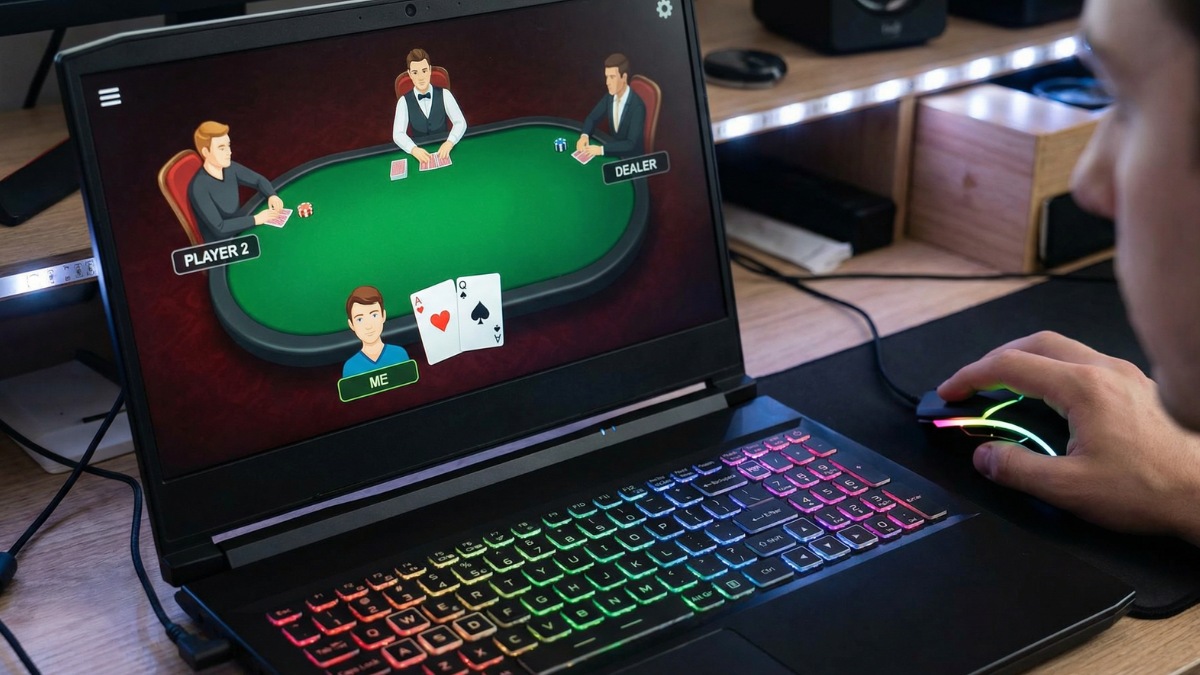
Who goes first in poker depends on the betting round. Pre-flop, action starts with the player to the left of the big blind; after the flop, turn, and river, the first active player left of the dealer button acts first.
This structure exists to control information flow. Players who act later see opponents’ decisions before committing chips, creating measurable differences in risk, error rates, and long-term profitability.
Who Goes First in Poker and Positional Advantage
Poker’s betting structure is built around a simple economic principle: information has value.
By forcing some players to act with limited data, the game creates natural imbalances that reward discipline, timing and statistical awareness. Understanding who bets first in poker is the foundation for evaluating every hand, from low-stakes online sessions to televised tournament play.
In regulated environments and competitive pools, these mechanics remain consistent across both live rooms and digital real money poker rooms, where standardized rules ensure uniform betting order.
Poker Turn Order Creates Information Gaps
In most dealer-button games, action moves clockwise around the table, beginning with the player positioned immediately after the forced bets. This rotation means early-position players commit chips before observing opponents’ responses, while late-position players collect behavioral and sizing data first.
Consider a nine-handed Texas Hold‘Em cash game. Each player receives two private cards, producing 1,326 possible starting hand combinations. A player acting first must evaluate strength without knowing whether stronger combinations, such as Ace-King suited or pocket Queens, are behind.
If four players remain, the chance that at least one has TT+ or AQ+ is about 17 percent.
This structural uncertainty increases decision-making error rates. In fact, a 2025 Journal of Gambling Studies paper links early-position pressure to higher impulsivity and faster bankroll depletion in recreational players.
Late Position Produces Measurable Edge
Players who act later operate with expanded informational bandwidth. They observe check patterns, bet sizing, hesitation timing and frequency shifts before committing capital. Over thousands of hands, this visibility translates into higher expected value.
Acting last lets you value bet thinner and bluff less often. Over time, that lowers mistake cost and raises realized equity.
An example: bluffing $60 into a $90 pot needs 40% folds. Out of position, you face bets first and lose that control.
This dynamic explains why professional players prioritize seat selection and positional awareness as core strategic assets, rather than secondary considerations.
Texas Hold‘Em Betting Order: Pre-Flop Rules
Before any shared cards appear, Texas Hold‘Em betting order follows rigid placement rules designed to offset the advantage of receiving information later in the hand. In most formats, forced wagers determine who starts betting in poker pre-flop.
Online networks, private clubs, and tournament circuits maintain nearly identical pre-deal frameworks. This includes no KYC sites that operate under alternative verification models, but preserve standard turn sequencing.
Blinds Determine Who Starts Betting in Poker
In games with small and big blinds, the first voluntary action is taken by the player seated immediately to the left of the big blind. This position is commonly referred to as “under the gun” and offers the most significant exposure during the opening betting phase.
In a $2/$5 Texas Hold‘Em cash game, the small blind posts $2 and the big blind posts $5 before cards are dealt. If nine players are seated, the under-the-gun player acts first with no visibility into future raises. When holding King-Jack suited, this player faces a statistical dilemma.
Early seats face the widest range of strong hands behind, which forces tighter opens than later seats because you will face more raises and fewer profitable calls.
Acting Early Limits Betting Flexibility
Opening-position players must commit capital without knowing whether opponents intend to call, raise, or trap. This uncertainty restricts maneuverability and increases reliance on predefined ranges, instead of situational reads.
Suppose a player raises to $20 with Ace-10 offsuit from under the gun in a six-handed game. Two callers and one re-raise to $75 follow. The original raiser now faces a pot of $172 with only $55 invested, requiring 24.2 percent equity to continue. Against typical three-bet ranges, Ace-10 offsuit rarely exceeds 21 percent equity, making the continuation mathematically unfavorable.
These scenarios explain why who starts the betting in poker often dictates downstream outcomes. Early action compresses options and magnifies mistakes.
| Seat | Forced Bet | Pre-flop Range Pressure |
| Under the Gun | None | Tightest opening range |
| Big Blind | Big blind | Widest defend range |
| Button | None | Widest raise range |
The table reflects how pre-deal positioning influences playable hand volume. Button players exploit informational leverage, while blind and early positions remain constrained by structural obligations.
Post-Deal Betting Order After Community Cards
Once shared or exposed cards enter play, betting order shifts away from blind-based sequencing and re-centers around table position. From the flop onward, who acts first in poker depends on proximity to the dealer button, rather than forced wagers.
This structure applies uniformly across cash games, tournaments, and streamed live dealer games where physical dealers and digital interfaces follow identical procedural standards.
Dealer Position Controls Post-Flop Action
After the first three community cards appear, action begins with the first active player to the left of the dealer button. This player is often referred to as being out of position for the remainder of the hand.
In a nine-handed game where five players reach the flop, the button acts last on every post-flop street. This creates a cascading advantage, as late-position players observe check patterns, continuation bets and defensive sizing before responding.
For example, consider a $1/$3 game where the button holds Ace-Queen of spades on a flop of Queen of hearts, 8 of clubs and 4 of diamonds. Two early-position players check. The button now controls pot size, allowing you to choose between a $12 value bet, a delayed bluff or pot preservation. Acting first removes this discretion.
In position, you realize more equity through checks, calls and sizing.
Why Last Action Shapes Profitability
Post-flop betting is where turn order drives most profit. Players who act last extract value more consistently and lose less when behind.
Assume a pot of $90 on the turn. An early-position player bets $45 with a middle pair. A late-position opponent holding top pair can raise to $135, forcing a fold or expensive call. If the order were reversed, this leverage disappears.
A river bet breaks even at B/(P+B) fold, where B = the size of your bet (the bluff) and P = the size of the pot before you bet.
| Street | First To Act | Last To Act |
| Flop | Left of button | Button, if still in |
| Turn | Left of button | Button, if still in |
| River | Left of button | Button, if still in |
These mechanics explain why who bets first after the flop remains one of the strongest predictors of hand profitability across formats.
Betting Order Across Poker Variants and Formats
While Texas Hold‘Em dominates global traffic, poker turn order operates under different mechanical rules in several major variants. Comprehending how who bets first in poker shifts between formats allows players to transfer positional discipline across cash games, tournaments and specialty tables.
Across international platforms and cryptocurrency-supported networks, such as Bitcoin poker sites, rule enforcement remains consistent across variants, preserving predictable betting hierarchies.
How Texas Hold‘Em and Omaha Maintain Button Control
In Texas Hold ’Em and Omaha, betting order is built around the dealer button and blind structure, following the standard rules outlined by Bicycle Cards, one of the most widely referenced authorities on poker mechanics. Pre-flop, the first voluntary action comes from the player seated immediately to the left of the big blind, with action moving clockwise. After the flop, turn, and river, betting begins with the first active player to the left of the dealer button, ensuring that positional advantage rotates evenly from hand to hand.
This same sequencing is enforced at the highest competitive levels. The WSOP 2025 Official Tournament Rules apply an identical button- and blind-based betting order across both ring games and tournament play, confirming uniform turn-order structure across major poker operators. Omaha follows the same positional framework as Texas Hold ’Em, although four-card starting hands increase equity variance and amplify the value of acting last.
Stud and Draw Games Assign Early Action
Seven Card Stud and traditional draw games abandon the button model entirely. Instead, visible card strength determines who acts first, particularly during early betting rounds.
In Seven-Card Stud, the player showing the lowest exposed card posts the bring-in and opens betting. If two players reveal identical low cards, suit ranking resolves priority. This system rewards observational accuracy, rather than seat position.
For example, a player showing 2 of clubs must act before an opponent showing 6 of spades, regardless of table placement. Over multiple streets, the betting order adjusts based on remaining exposed cards, creating dynamic rather than fixed positioning.
In draw games such as Five-Card Draw, the first bettor is determined by fixed seating or proximity to the dealer, depending on house rules. Some European operators allow the button to open post-draw betting, while North American rooms frequently assign action to the left of the dealer.
These variations highlight why the question of “Who acts first in poker?” cannot be answered without understanding the underlying format.
Now You Know Who Acts First in Poker
Across blinds, buttons and exposed-card systems, who goes first in poker follows consistent economic logic that prioritizes information flow and risk distribution. Pre-deal rules define who starts betting in poker, post-flop structures determine who bets first after the flop and variant-specific frameworks adjust positioning without abandoning core principles.
Players who master these mechanics improve hand selection, reduce positional losses and exploit late-action leverage more efficiently.
Please play responsibly. 21+, T&Cs apply.