

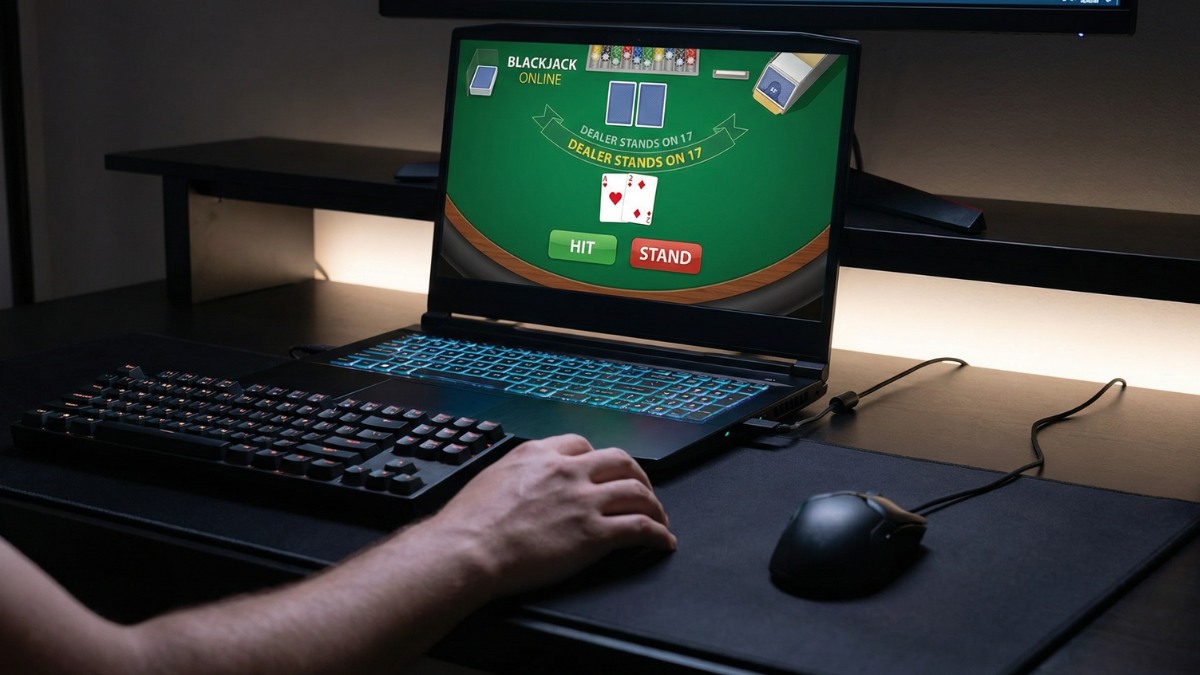
In most six-deck blackjack games paying three-to-two, correct decisions about when to hit in blackjack can reduce the house edge to nearly 0.5 percent under standard rules. That margin separates long-term losses from competitive play.
Understanding when to hit and stand in blackjack depends on card distribution, rules, and probability, not instinct.
When to Hit in Blackjack: Core Hit and Stand Rules
Every blackjack hand begins with the same mechanical choice: take another card or lock in the total. Before strategy charts and simulations matter, players must understand how hitting and standing function at the table.
Many online platforms offering the option to play real money blackjack online follow these same foundational rules, making this framework applicable to both land-based and digital games.
Unlimited Hits Until a Decision Is Locked
Blackjack rules allow players to request additional cards until one of two outcomes occurs: the hand reaches a chosen stopping point or exceeds 21 and busts. There is no formal limit on how many times a hand may be hit, whether playing a single deck or an eight-deck shoe.
For example, a hand starting with 4 and 3 totals 7. A player may hit and receive 2 for 9, hit again for 5, reaching 14, hit again for 3, reaching 17, and still continue if desired. Only when the player signals a stand does the sequence end. If the next card pushes the total beyond 21, the hand immediately loses regardless of the dealer’s outcome.
From a probability standpoint, this freedom matters. In a standard six-deck game, drawing a card valued at 10 has a probability of about 30.8 percent due to the concentration of 10, Jack, Queen, and King cards.
Knowing this risk shapes every hit decision.
Standing Ends All Future Card Options
Once a player stands, the hand is finalized, and no further cards may be taken under any circumstance. This rule applies equally to totals of 12 and totals of 20. Standing is irreversible, even if the dealer later reveals a weak hand.
Consider a player holding 16 against a dealer’s 10. Standing locks in a statistically weak position, with long-term loss rates exceeding 53 percent in most multi-deck games. Hitting introduces bust risk, but also opens paths to totals of 17 through 21 that can compete.
This finality explains why questions like “How many times can you hit in blackjack?” matter less than understanding when to stop. The only structural limitation is the commitment created by standing, not a cap on drawn cards.
When to Hit in Blackjack Using Basic Strategy Charts
Basic strategy removes guesswork from blackjack by translating millions of simulated hands into clear mathematical instructions. It defines when to hit in blackjack by measuring expected value against every possible dealer upcard.
Many modern platforms that support blackjack crypto gambling publish these charts alongside their rule sets, since even minor variations such as dealer soft 17 rules can shift optimal decisions.
Hard, Soft and Pair Hands Require Different Math
The basic strategy separates hands into three categories based on their risk profiles: Hard hands contain no Ace valued at 11, soft hands include an Ace valued at 11, and pairs involve two identical cards that may be split.
A hard 15 against a dealer 10 is vulnerable because more than 58 percent of dealer outcomes will reach 17 or higher. Hitting offers approximately a 38 percent chance of improving to 17 through 21, while standing locks in a negative expectation.
In contrast, a soft 17 allows aggressive hitting because the Ace can absorb a high card without immediate risk of busting.
Pairs follow their own logic, whereby two 8s should be split against most dealer upcards, even though 16 is traditionally weak. In a six-deck S17 game, splitting 8s against a dealer 9 improves return by about 0.13 units per hand versus standing (roughly 13 units per 100 hands).
This framework explains why knowing when to hit or stand in blackjack cannot be reduced to intuition. Each category responds differently to card removal and payout probabilities.
Why Charts Reduce the House Edge Below One Percent
In standard six-deck games with late surrender and dealer standing on soft 17, basic strategy reduces the house edge to roughly 0.46 percent. Without a strategy, casual players often face edges of two percent or more.
The difference comes from precision; strategy charts evaluate every player’s total against every dealer’s upcard using long-run averages. These calculations assume infinite play and consistent rules, which is why deviations increase expected losses.
The table below illustrates common hard-hand decisions under typical six-deck rules.
| Player Hand | Dealer Upcard | Optimal Action |
| Hard 12 | 2 | Hit |
| Hard 12 | 4 | Stand |
| Hard 13 | 7 | Hit |
| Hard 16 | 10 | Hit |
| Hard 17 | 9 | Stand |
Each cell reflects millions of simulated outcomes. For a 10+6 hard 16 against a dealer 10 in a six-deck, S17 game, standing returns about -0.541 units while hitting returns about -0.535 units, a gain of roughly 0.006 units per hand. Over 10,000 hands, that gap is about 63 betting units, not hundreds.
Rule variations also matter. At Caesars Palace Las Vegas, where dealers stand on soft 17, basic strategy produces slightly higher returns than at properties using hit-on-soft-17 rules. Meanwhile, some European online casinos restrict surrender options, making precise hit timing even more critical.
Understanding these nuances helps explain when you should hit in blackjack across different environments and why generic advice often fails.
When to Hit in Blackjack in Common Table Scenarios
Certain blackjack hands create more hesitation than others because the margin between winning and losing narrows dramatically. Being aware of when to hit in blackjack in these moments depends on how dealer strength interacts with player totals.
In environments such as live dealer casinos, where real-time pacing mirrors physical tables, these high-pressure decisions occur frequently and leave little time for second-guessing.
Hit or Stand on 16 Against Strong Dealer Cards
A hard 16 is the most debated hand in blackjack because it sits one point below the dealer’s minimum standing requirements. Against dealer cards valued 7 through Ace, this total performs poorly under almost every rule set.
Cache Creek Casino Resort explains that players holding 16 against a dealer’s 10 face a statistically unfavorable position, regardless of instinct or table mood. Hitting still carries risk, but the immediate bust probability is about 38.5 percent in a six-deck shoe.
Under common six-deck S17 rules, standing on 10+6 versus a dealer 10 returns about -0.541 units. Hitting improves that slightly to about -0.535 units, which is why basic strategy prefers the hit if surrender is not available. The improvement appears small, but over 5,000 hands, it equals about 30 betting units.
This is why hit or stand on 16 decisions favor the hit here. When evaluating when to hit on blackjack, players must weigh immediate bust risk against long-term survival.
The following table summarizes typical hard 16 outcomes in six-deck games.
| Dealer Card | Dealer Bust Rate | Optimal Action |
| 7 | 26.19% | Hit |
| 9 | 22.92% | Hit |
| 10 | 23.02% | Hit |
| Ace | 16.70% | Hit |
| 6 | 42.28% | Stand |
Dealer 6 is the swing card because the dealer busts about 42 percent in a six-deck S17 game, so you win more by letting the dealer draw out.
Soft 17 and 12 Versus Dealer Pressure
Soft 17, composed of Ace and 6, confuses many players because it resembles a strong total while remaining highly flexible. Unlike hard hands, soft totals tolerate aggressive play without immediate collapse.
Against dealer 7 through Ace, hitting soft 17 increases expected return by creating paths to 18, 19, and 20. Standing restricts those outcomes and surrenders initiative to the dealer. In six-deck S17, soft 17 vs. 9 favors hitting by about 0.12 per 100 hands.
Hard 12 presents a different challenge. It sits between safety and danger, particularly when facing low dealer cards. Against the dealer, 4, 5, or 6, standing is optimal due to high dealer bust frequency. Against 2, 3, or 7 and above, hitting becomes mathematically superior.
These decisions demonstrate that blackjack hit-or-stand outcomes depend more on opponent exposure than on personal comfort. Knowing when to stand in blackjack requires recognizing when the dealer is statistically vulnerable.
The table below outlines common soft 17 and hard 12 scenarios.
| Player Hand | Dealer Upcard | Optimal Action |
| Soft 17 | 8 | Hit |
| Soft 17 | 10 | Hit |
| Soft 17 | 6 | Double |
| Hard 12 | 4 | Stand |
| Hard 12 | 7 | Hit |
Double-down opportunities appear when probability favors controlled risk. On soft 17 versus 6, doubling raises long-term returns by exploiting dealer bust rates exceeding 40 percent.
These examples reinforce why when to hit or stay in blackjack cannot be reduced to rigid habits. Each total reacts differently to shifting dealer leverage.
When to Hit on Blackjack Within Responsible Play Models
Basic strategy only works if you actually follow it. The fastest way to turn a 0.4 to 0.6 percent edge into a one percent-plus edge is to freeze on the hands that feel scary, especially 12 through 16 against a dealer 7 through Ace.
Players who frequent ETH gambling sites often encounter higher betting limits and faster game cycles, which makes correct execution more important.
A 2025 working paper, “A Formal Game-Theoretic Model of Blackjack: Strategic Decision-Making under Imperfect Information,” models imperfect decision-making and reports that strategy deviations can materially increase losses over long sessions. If you are not willing to make the correct hit or stand decision, lower your stakes or stop.
Here is a concrete bankroll checkpoint: If you are betting $25 per hand, keep at least $2,500 in reserve, so a typical downswing does not force conservative play. Under basic strategy, a $10 flat bet across 300 hands at a 0.5 percent house edge implies an expected loss of about $15. If deviations push the edge to 1.2 percent, the expected loss rises to about $36.
Now You Know When to Hit in Blackjack
Knowing when to hit in blackjack comes down to disciplined math, situational awareness, and consistent execution. Strong players rely on probability, respect rule variations, and protect their bankroll to keep decision-making stable over time.
Blackjack stand-or-bust math beats guesswork.
Please play responsibly. 21+, T&Cs apply.