

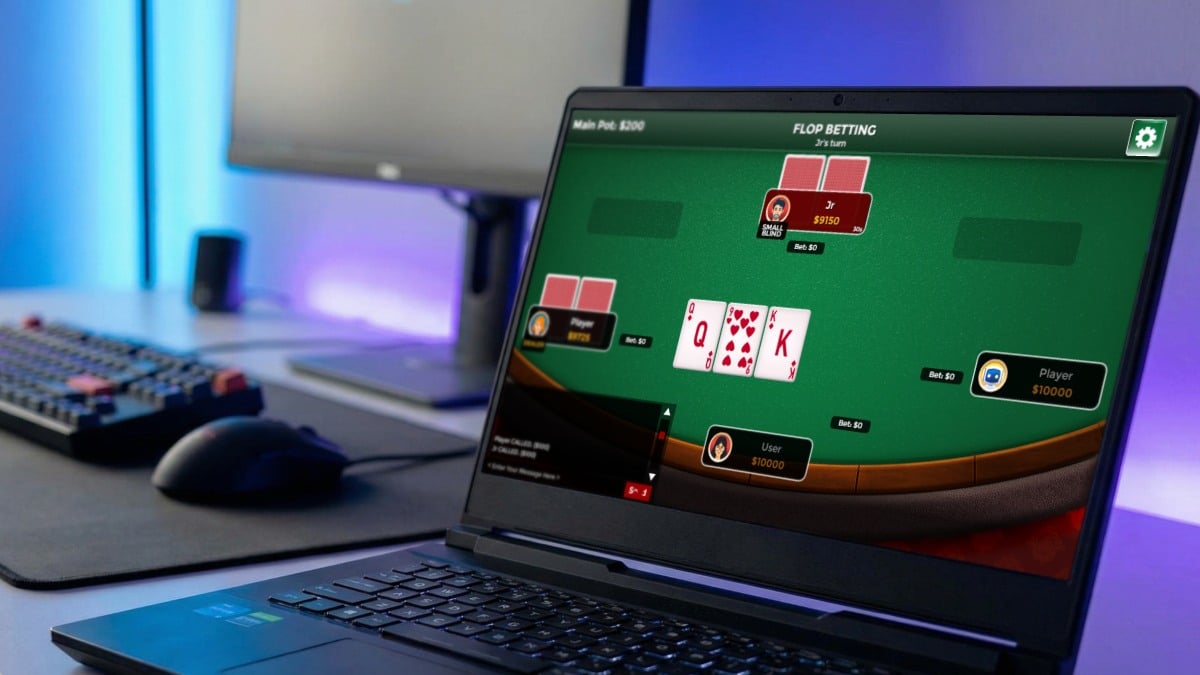
When players talk about VPIP poker, they mean the percentage of hands where someone chooses to put chips in before the flop when folding was an option.
The stat tracks calls, limps, and raises, then compares them with all hands dealt. A tight regular might have VPIP around 18–20 percent, while a loose player can sit above 30 percent.
That single number already shows how wide or narrow a player’s preflop range runs.
What Does VPIP Mean in Poker?
VPIP stands for “Voluntarily Put Money in Pot.” It measures how often a player enters a pot by choice before the flop, instead of folding. Blinds and antes that you must post do not count, because they are forced bets rather than voluntary action.
In simple terms, the VPIP formula is:
VPIP (%) = (Number of hands where you voluntarily put money in preflop ÷ Total hands dealt) × 100
If you sit in a six-max cash game for 1,000 hands and put chips in voluntarily in 220 of them, your VPIP works out to 22 percent. That mark usually lines up with a fairly tight-aggressive style in many online poker pools. A player who plays 350 of those 1,000 hands would show VPIP of 35 percent, which points to a much wider starting range.
What Counts Toward VPIP and What Does Not
VPIP only tracks voluntary preflop decisions, not forced bets:
- Counts for VPIP: any voluntary limp, call, raise, or re-raise before the flop.
- Counts for VPIP: defending the big blind with a call or raise after an open.
- Does not count: posting the small blind or big blind and then folding to a raise.
- Does not count: getting a free look in the big blind when everyone else limps or folds and you check.
Voluntary Put-In-Pot and Real Winrate Bands
VPIP in poker shows how wide a player sits preflop and has a clear link to long-run winrate. Very low numbers, such as 8–12 percent, usually come from players folding almost everything and reaching the flop with narrow, face-up ranges. Extremely high numbers, above 35 percent, often show up in loose calling styles that chase dominated hands.
Many winning regulars in six-max no-limit games cluster somewhere around 18–24 percent VPIP, with a healthy portion of those hands raised rather than limped. Full-ring cash games often tighten that band to roughly 15–20 percent, because extra seats push more marginal holdings into the muck. Tournament fields can spike into the high 20s when stacks shorten and open-shove ranges widen, especially in late-stage or bounty formats.
In long tracking samples from common online pools, players with VPIP in the mid-teens to low twenties most often show steady winning results, while very low or very high VPIP profiles tend to cluster closer to breakeven or long-run losses. Those patterns do not guarantee a specific win rate for any individual player, yet they match consistent trends seen in large databases.
VPIP Ranges, Playing Styles, And What They Signal
VPIP bands give a fast snapshot of style before any post-flop information. Once a sample reaches a few thousand hands, that range says a lot about how someone picks starting hands and how often they enter the pot in the first place.
The table below shows approximate VPIP bands for common no-limit hold’em formats; these ranges describe common tendencies in tracked databases, not strict targets:
| VPIP band | Typical style tag | Sample stake / format | Rough PFR % | Common leak |
| 10–15% | Very tight | Live $2/$5 cash | 8–12% | Over-folding in blinds, missing value spots |
| 16–20% | Tight-aggressive | Online NL25 six-max | 13–17% | Folding a bit too often versus 3-bets |
| 21–25% | Active TAG | Online NL50 six-max | 17–21% | Light opens from late position |
| 26–32% | Loose-aggressive | WSOP.com mid-stakes cash | 20–24% | Barreling too wide, thin calls out of position |
| 33–40% | Loose-passive mix | $1/$3 live cash home-style | 10–18% | Too many calls preflop, dominated kickers |
These bands do not act as strict rules, yet they give context. A player with VPIP at 32 percent and PFR at 12 percent calls far more than they raise, which usually points to loose-passive tendencies. Someone sitting at 19/17 often runs a tighter, more aggressive strategy that presses edges with opens and 3-bets instead of limps and calls.
Recent training material and aggregated database examples for NL25 and NL50 player pools usually show long-term winners clustered in roughly the 18–24 percent VPIP band with PFR a few points lower, while large losers tend to appear in the 30-plus VPIP and single-digit PFR range, based on long-run samples from large pools of online hands at those stakes.
One Full Orbit: Which Hands Count For VPIP?
VPIP tracks decisions, not seats, so an orbit at six-max shows how numbers move as action shifts. Across nine hands, some spots add to that percentage, others leave it unchanged, even when the big blind posts chips.
- Hand 1: UTG opens with K♠ Q♠, VPIP +1 for UTG.
- Hand 2: Hijack limps 7♥ 7♦, cutoff raises, limper calls, both gain +1 VPIP.
- Hand 3: Button folds 9♣ 5♣ to an early open, no VPIP change.
- Hand 4: Small blind completes after several limps, VPIP +1 for small blind.
- Hand 5: Big blind defends Q♦ J♦ versus a raise, VPIP +1 for big blind.
- Hand 6: Everyone folds, blinds walk through, no VPIP change.
- Hand 7: CO 3-bets A♠ K♣ over a raise, VPIP +1 for CO.
- Hand 8: UTG open-shoves short stack, VPIP +1 for UTG only.
- Hand 9: Big blind checks option after limpers, no VPIP change.
VPIP Across Formats: 6-Max, Full Ring, And Live Rooms
VPIP does not sit in the same band in every format. Six-max online no-limit games often reward activity, so many solid regulars land between 18 and 26 percent, with most of that range opened rather than limped.
Full-ring online cash tends to shift tighter, and winning players often settle in the 14–20 percent window, especially when rake pressure rises at micro and small stakes. High rake at those limits often rewards a slightly tighter preflop approach, because wider VPIP ranges push more marginal hands into expensive pots.
Live poker introduces slower pace and softer lineups, which pulls average VPIP upward. In many $1/$3 rooms in Nevada and regional US casinos, it is common to see regulars in the 25–32 percent range, with local recreational players sometimes climbing past 40 percent over a session.
Hand-history sets from major online rooms and training material from established tracking-tool providers such as PokerTracker and Hold’em Manager show similar bands for typical tight-aggressive and loose-aggressive styles in 2024 and 2025.
HUD Context: VPIP With PFR and Aggression
VPIP on a HUD makes sense once it sits next to PFR, 3-bet percentage, and aggression numbers. The gap between VPIP and PFR, in particular, shows how often a player limps or calls instead of raising. That relationship matters more than a single raw percentage.
- VPIP 22 / PFR 18 / 3-bet 7: Classic tight-aggressive profile in six-max games, entering roughly one hand in five and raising most of those spots.
- VPIP 30 / PFR 8 / 3-bet 2: Loose and passive, calling in roughly one hand in three, yet raising less than one in ten; this player gives up initiative often.
- VPIP 26 / PFR 22 / 3-bet 10: Active regular, opening and 3-betting a lot, especially at mid stakes where aggression frequencies trend upward in recent HUD samples.
- VPIP 18 / PFR 10 / 3-bet 1: Very cautious, usually flatting strong hands preflop and slow-playing premiums, which can punish unaware opponents but caps long-run winrate.
Patterns like these show whether that VPIP percentage comes from raises, calls, or a mix that leans passive.
Strategy Tweaks Against Different VPIP Profiles
VPIP poker ranges give a quick cue for practical adjustments. Once a player pool or individual opponent shows a stable number over a few hundred hands, preflop plans can shift in measured ways.
- Against very tight players (VPIP under 15): Open wider on their blinds, especially from late position, and 3-bet a bit more often in position. These players fold a high share of hands, so even small increases in steal frequency can add up over 100+ orbits.
- Against standard TAGs (VPIP 18–23): Respect early-position raises, yet apply pressure on wide button and cutoff opens with selective 3-bets. A value-heavy 3-bet range around 7–9 percent works well against this band in many rake environments.
- Against active regulars (VPIP 24–28): Widen 4-bet bluffs slightly, especially when their 3-bet rate passes 9–10 percent, and trap occasionally with premium hands instead of auto 4-betting.
- Against loose-passive players (VPIP 30+ with low PFR): Isolate bigger with hands ahead of wide calling ranges, sometimes to 5–6 big blinds, and fold more of the bottom of your own defending range. These players often call 50 percent or more of opens from late position and still fold too many flops.
Long-run tracking in online pools supports these adjustments; high-volume databases where VPIP, PFR, and 3-bet stats are tied to actual results tend to show the most consistent winners in line with standard TAG or active TAG bands, not at the loose-passive extremes.
Keeping VPIP In Perspective
VPIP helps turn scattered hands into a clearer pattern, yet it stays only one page in the wider book of a player’s game. The number shows how eager someone is to step into pots, not how they handle turns and rivers or pressure spots near a final table. Strong players treat VPIP as a guide for reading ranges and spotting leaks, then cross-check it with post-flop lines, bet sizes, and positional awareness.
Sample size matters a lot. A handful of sessions or a few hundred hands can swing wildly from card rushes or cold stretches. Databases tracked in widely used software such as PokerTracker and Hold’em Manager often show VPIP stabilizing once a player has logged roughly 3,000 to 5,000 online hands in the same seat. With that many hands recorded, VPIP moves from a vague hint to a firmer anchor for decisions.
Poker works best when the game stays under control, not the other way around. Gamble responsibly; for help call 1-800-GAMBLER.