

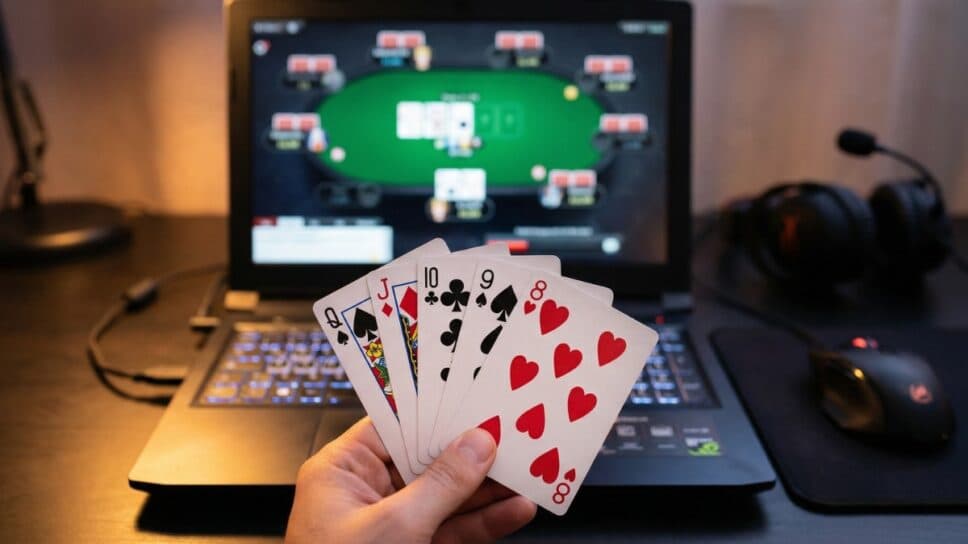
A straight is five cards in numerical sequence, and suits do not matter unless all five cards are the same suit, which makes a straight flush.
This guide covers straight poker rules, all possible straights in poker, how straights work in poker, and straight in Texas Hold ’Em, plus the fast comparisons that answer does trips beat straight and does a straight have to be the same suit.
What Is a Straight in Poker and How Does It Form?
A straight poker hand is determined entirely by sequence, not visual uniformity. Clear recognition matters because misreading sequences remains a recurring technical mistake under straight poker rules.
Below are all possible straights in poker (10 sequences):
Straight Name Sequence Highest Card | Wheel A-2-3-4-5 5 | Six-high straight 2-3-4-5-6 6 | Seven-high straight 3-4-5-6-7 7 | Eight-high straight 4-5-6-7-8 8 | Nine-high straight 5-6-7-8-9 9 | Ten-high straight 6-7-8-9-10 10 | Jack-high straight 7-8-9-10-J J | Queen-high straight 8-9-10-J-Q Q | King-high straight 9-10-J-Q-K K | Broadway 10-J-Q-K-A A |
Aces only play low in A-2-3-4-5 or high in 10-J-Q-K-A, never as a wraparound card (Q-K-A-2-3 is not a straight).
Straight Poker Rules and Card Sequences
Under straight poker rules, a straight is defined solely by five consecutive ranks, with the ace functioning only as the highest or lowest card in a sequence. A hand such as queen-king-ace-two-three does not qualify as a straight.
The lowest qualifying straight is ace through five, commonly called the wheel, while the highest straight runs from ten through ace. Ten distinct sequences qualify as all possible straights in poker, and this fixed structure allows precise probability modeling during play.
There are 10,200 unique five-card straights when straight flushes are excluded, which is 0.3925 percent of all five-card hands, about 1 in 254 deals. In straight in Texas Hold ’Em, an open-ended straight draw on the flop completes by the river about 31.5 percent, while a gutshot completes about 16.5 percent.
These probabilities are derived from standard combinatorial analysis used in poker mathematics and are consistent with published odds tables from the World Series of Poker and academic probability modeling.
That figure directly informs call thresholds and pot-odds calculations in competitive environments, including regulated real money poker rooms.
Does a Straight Have to Be the Same Suit?
A straight does not require matching suits; when all five cards share the same suit while forming a sequence, the hand upgrades to a straight flush and no longer qualifies as a straight hand under ranking rules.
This distinction is frequently misunderstood in fast-paced settings, particularly on visually coordinated boards.
Straight Poker Rules: Showdown, Board Straights and Ties
- If the board itself shows a straight (for instance, 9-10-J-Q-K), players can play the board, and the pot is split unless someone can make a higher straight using a hole card.
- Two straights are compared by the highest card only. Suits do not break ties in standard poker.
- In Texas Hold ’Em, your straight can use zero, one, or two hole cards. In Omaha, it must use exactly two hole cards and three board cards.
Where Straight Poker Hands Rank at the Table
A straight occupies a middle tier in the poker hand hierarchy, strong enough to pressure weaker holdings while remaining vulnerable to higher-made hands. Its value depends on rank ordering rather than suits, which simplifies comparisons but raises strategic stakes.
Straight Poker Hands in the Ranking Hierarchy
Under standard poker rankings, a straight beats high card, one pair, two pair, and three of a kind. It loses to a flush, a full house, four of a kind, and a straight flush. This placement explains why a straight often triggers aggressive betting while still requiring caution on coordinated boards.
Behavioral data reinforces this hierarchy. A 2024 peer-reviewed study examining online poker decision-making found that mid-strength made hands, including straights, produced the highest rates of delayed betting and reevaluation when boards showed flush or pairing potential.
These hesitation patterns were linked to increased cognitive load during risk assessment in digitally mediated play, as documented in the GREO evidence review titled “Neural bases of decision-making in online poker gambling.”
How Straights Are Compared Against Each Other
When two or more players hold a straight, the winner is determined solely by the highest card in the sequence.
Hand Question Winner Why | Do trips beat straight? Straight A straight ranks above three of a kind in standard hand rankings | Does a straight have to be the same suit? No Suits do not matter for a straight; same-suit straight is a straight flush | Straight vs straight Highest straight Highest card in the sequence determines the winner | Wheel vs 6-high straight 6-high straight 6-high outranks 5-high |
If you remember one rule, remember this: straights are rank math, not suit math. That same ranking logic applies in cash and tournament play, including on Bitcoin poker sites.
How Straights Appear Across Poker Game Formats
Straights emerge differently depending on how the cards are distributed and shared. Community card games emphasize board texture and shared equity, while closed-hand formats reward memory and sequencing discipline.
Straights in Community Card Poker Games
In Texas Hold ’Em and Omaha, straights often develop through coordinated boards, rather than private card dominance. Connected flops such as seven-eight-nine or boards with single gaps like six-eight-nine create immediate straight pressure. In Hold ’Em, players use any combination of hole cards and board cards to form a straight.
A Hold ’Em example is as follows: The board shows six, seven, eight, king, and two. You hold nine and ten. Using your nine and ten with the six, seven, and eight on the board creates a six-to-ten straight.
Further, as an example in Omaha, the board shows six, seven, eight, king and two. You hold nine, ten, ace, and ace. You may use the nine and ten together with the six, seven, and eight on the board to form a straight, because Omaha requires exactly two hole cards and three board cards.
Players who prefer a live-dealer interface can find poker-adjacent options at top live dealer sites.
Game Format Straight Frequency Vulnerability Level Typical Pot Size Impact | Texas Hold ’Em Moderate Medium Strong value driver | Omaha Hi High High Conditional value | Five Card Draw Low Low Showdown dependent | Seven Card Stud Moderate Medium Position sensitive |
Straights in Private Card Poker Variants
In Five Card Draw and Seven Card Stud, straights rely entirely on private information and exposed cards. With no shared board, recognizing dead cards becomes critical.
In Seven Card Stud, visible upcards reduce the number of available straight combinations, altering drawing odds in real time.
Five Card Draw presents fewer straight opportunities due to limited card replacement. However, completed straights in this format often carry stronger relative value because flushes and full houses appear less frequently.
Understanding these format-specific dynamics helps players evaluate straight hand strength without overcommitting chips in structurally unfavorable spots.
Strategic Play Considerations When Holding a Straight
A straight often signals strength but rarely guarantees safety. Its profitability depends on board texture, opponent tendencies, and positional awareness rather than raw hand ranking.
Value Betting and Board Awareness
Aggressive betting with a straight makes sense when the board limits higher-made hands and redraws. World Series Poker (WSOP) notes that “it’s better to be in a late position (i.e., closer to the button) than an early position because you’ve got more information to work with. If you’re in a late position with a Straight, it’s easier to get maximum value from your hand.”
Dry boards with few suited cards or paired threats allow straights to extract value from top pair and two-pair holdings. Late position enhances this advantage by revealing opponent intent before chips are committed.
These dynamics appear frequently across regulated platforms and emerging markets, including environments supported by crypto sites, where fast betting cycles amplify positional edges.
Blockers, Redraws, and Risk Control
Understanding blockers and redraw potential separates disciplined straight play from costly overextensions. In Omaha, holding the nut straight without flush blockers often invites disaster on turn and river cards. Even in Hold ’Em, a straight on a two-tone board loses value without suit coverage.
The table below outlines common straight scenarios and their relative exposure:
Straight Scenario What to Check Threat Level | Hold ’Em straight on the rainbow board No flush draw, no pair Low | Hold ’Em straight on two-tone board Flush draw present Medium | Hold ’Em straight on a paired board Full house risk High | Omaha nut straight, two-tone, multiway Redraws to a higher straight, flush Very high |
Evaluating these factors in real time helps preserve equity while still capitalizing on favorable spots. For those wondering how do straights work in poker draws (Texas Hold ’Em odds):
Draw Type Outs Flop to River Chance Practical Meaning | Open-ended straight draw 8 31.5% You hit about 1 in 3 by the river | Gutshot (inside) straight draw 4 16.5% You hit about 1 in 6 by the river |
These draw-completion rates define the baseline equity thresholds used in professional pot-odds calculations, not guarantees of profitability, and lose predictive power as board coordination and multiway participation increase.
Land Your Next Straight Poker Hand
A straight hand performs best when it is high, such as Broadway or king-high, and the board does not indicate a flush or full house. Use the 10-sequence list above to confirm your exact straight hand, then reference the draw-odds table to judge whether a call is mathematically justified before committing chips.
Practice hand recognition in real-money poker rooms, then compare game speed and variance across crypto casino sites and live dealer online casinos. All rankings assume standard high-hand rules only.
Please play responsibly. 21+, T&Cs apply.


