

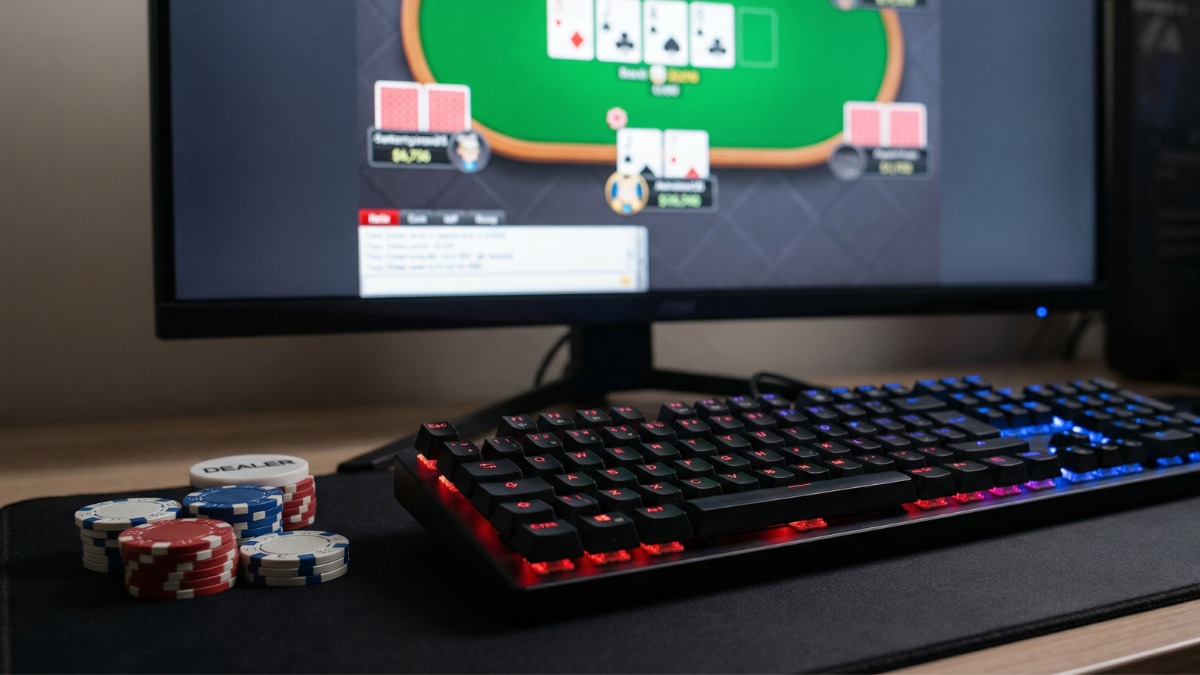
Poker chip distribution works when stacks and denominations match the blind level. Start by choosing a target stack in big blinds, then pick chip values that build common bet sizes without repeated change-making.
Cash games need flexible rebuys; tournaments need a stable structure with planned color-ups. A consistent setup keeps common opens and postflop bets buildable in 2–6 chips, which reduces miscounts and stop-the-hand rechecks.
Poker Chip Distribution for Texas Hold’Em
Poker chip distribution works best when stacks and blinds are planned together. Use big blinds as the anchor instead of raw chip totals, whether you’re doing it for online formats or live.
For cash games, 100 to 200 big blinds per player is a practical target that supports normal preflop raises and postflop bet sizing without forcing early all-ins. For tournaments, 150 to 300 big blinds is a common opening range, then stacks compress as blinds rise on a schedule.
- Target Stacks (Cash): A $1 big blind game, or its home-game equivalent, usually starts players at 100 to 200 big blinds. In chips, that often lands around 2,000 to 5,000 per seat, depending on denominations. Keep rebuys simple by using the same stack size and chip mix each time.
- Tournament Target Stacks: Tournament stacks look larger because blind labels are larger. A practical home structure is 20,000 to 50,000 chips paired with blinds like 100/200 or 100/100. The ratio matters more than the headline number; opening deep gives players room for postflop decisions before levels pressure stacks.
Baseline Poker Chip Values
Chip values control how many chips a player needs to build standard bets; fewer chips per bet lowers counting errors. A practical ladder for most home Texas Hold’Em games:
- 1 unit: antes or the smallest blind
- 5 units: small raises and early streets
- 25 units: primary chip once blinds climb
- 100 units: turn and river sizing
- 500 units: deeper stacks and late tournament levels
At 1/2 blinds, this supports raises like 6, 8, or 10 with simple chip groupings. At 100/200, most action can run on 100s and 500s, with 25s for small adjustments.
As a quick cap, keep the smallest denomination to roughly 10–15% of a starting stack in cash games unless antes require more.
Quick Betting Examples Using the Ladder
Cash example (1/2): open to 8 can be built as one 5 + three 1s. A flop c-bet of 10 is two 5s. A turn bet of 25 is a single 25 instead of five 5s.
Tournament example (100/200): open to 500 is one 500. A flop bet of 700 is one 500 + two 100s. Once the big blind reaches 400, the 25 chip stops helping and should be queued for color-up.
Chip Breakdown for 5–20 Players (Per-Player Stacks)
Examples assume Texas Hold’Em with no antes at the start; cash formats allow limited rebuys.
| Player count | Starting stack target | Chips per player (adds to stack) |
| 5–6 | 2,000 units (100 BB at 10/20) | 10×1, 18×5, 24×25, 13×100 |
| 7–8 | 3,000 units (150 BB at 10/20) | 10×1, 18×5, 24×25, 23×100 |
| 9–10 | 5,000 units (100 BB at 25/50) | 20×5, 20×25, 24×100, 4×500 |
| 11–12 | 10,000 units (200 BB at 25/50) | 20×5, 20×25, 34×100, 12×500 |
| 13–16 | 20,000 units (200 BB at 50/100) | 24×25, 24×100, 18×500, 8×1,000 |
| 17–20 | 30,000 units (300 BB at 50/100) | 40×25, 30×100, 32×500, 10×1,000 |
Fast totals check: multiply each denomination by its count, then confirm the sum matches the stated starting stack before dealing. If totals are correct but stacks feel chip-heavy, increase denomination values before increasing stack size.
Bank rule for fewer stalls: target 20–24 mid chips per player in the working denomination (25s in small games, 100s in bigger games). If the bank cannot cover that, reduce starting stacks or shift value upward so routine flop and turn bets do not require making change.
A published 2025 WSOP structure sheet opens at 100/200 with a 40,000 starting stack, equal to 200 big blinds. That depth also works for a home tournament; only the chip labels change.
A practical denomination plan for that start is to run most bets on 100s and 500s, limit 25s to small adjustments, and plan the first color-up once the big blind reaches 400 or higher. This keeps common opens (500) and flop bets (600–900) buildable without breaking chips.
If you mirror that 200 BB start at home and in real money poker games, the same denominations stay workable for several levels before the first planned color-up.
How Many Chips Do You Start With in Poker? Cash vs Tournament Examples
Answering the question how many chips do you start with in poker comes down to format. Cash games usually tie stacks to the big blind because buy-ins stay open and players can reload. A common home setup starts each seat at 100 to 200 big blinds. If blinds are 10/20, that range equals 2,000 to 4,000 units per player, using chip values that make 3x to 5x raises easy to build.
Tournaments measure stacks the same way early on, even though the numbers look larger. A home tournament might start at 100/200 blinds with 20,000 chips, which equals 100 big blinds. Deeper events often open at 150 to 300 big blinds, then move stacks downward as levels rise on a schedule.
Use these bank mixes to avoid running out of mid denominations.
| Set size | Best use case | Example bank breakdown |
| 300 | 4–6 players, modest stacks | 100×1, 80×5, 80×25, 40×100 |
| 500 | 6–10 players, flexible cash | 100×1, 100×5, 150×25, 100×100, 50×500 |
| 1,000 | 10–20 players, deeper tournaments | 150×25, 250×100, 350×500, 250×1,000 |
Checkpoint: total chips needed for starting stacks, then keep a small buffer for rebuys and color-ups.
Poker Chip Distribution for Cash Games: Blind-to-Stack Mapping
Pick a big blind, choose a stack target, then match denominations so standard opens use a small number of chips.
- 1/2: stack 200–400 (100–200 BB); prioritize 1, 5, 25, 100
- 2/5: stack 500–1,000 (100–200 BB); prioritize 5, 25, 100, 500
- 5/10: stack 1,000–2,000 (100–200 BB); prioritize 25, 100, 500, 1,000
How to Set Up Poker Chips and Distribute Them Fairly
Knowing how to set up poker chips starts with preparation away from the table. Pre-building stacks saves time and prevents disputes over counts. Many hosts bag stacks in advance or build uniform columns, then distribute them seat by seat before the dealer button moves.
Fair distribution starts with identical stacks built from the same chip mix. Assign one person as banker to handle rebuys and color-ups, and keep higher-denomination chips off the table until they are needed. Rebuys should use the same stack size and chip mix as the original buy-in unless the group agrees on a change before the game starts.
Online formats influence expectations here. Some players arrive from platforms that promote reloads or poker bonuses, where stacks refresh instantly. Home games run smoother when rebuy limits and timing are stated clearly, so chip flow stays controlled and predictable.
Tournament rules for major series emphasize consistent chip handling, including clear color-up procedures and chip race limits, because those steps prevent disputes when fields are large.
Poker Set Up: Step-by-Step at the Table
Use one order every time:
- Assign the dealer button.
- Post blinds and confirm the opening level.
- Hand out pre-counted stacks; verify totals once.
- Put the remaining chips in a central bank by denomination.
- State rebuy rules or late entry limits, including any cutoff time.
- Rebuy handling: accept rebuys only between hands, have the banker announce the amount, and place chips on the table only after the current hand ends to avoid pot and stack confusion.
Common Chip Distribution Mistakes That Slow a Game Down
The most common issue is too many low-denomination chips. When every bet needs stacks of 1s and 5s, pot building drags, and mistakes show up faster.
Another frequent problem is skipping the middle of the value ladder. A set that jumps from 25 straight to 500 can force awkward change-making on routine turn bets, especially in deeper games.
Stack depth mismatches cause trouble, too. A game that starts at 25/50 with 1,000-unit stacks creates only 20 big blinds, so players get pushed into shove-or-fold decisions early. If the goal is normal postflop play, stacks closer to 100 big blinds are the safer starting point, paired with enough 100-value chips to cover standard raise sizes.
Color-Up Rules: When to Remove Small Chips
Color-ups prevent tiny chips from clogging pots once blinds rise.
- Trigger: remove the smallest chip when it is 10% or less of the big blind for more than one level.
- Announce it: pause between hands and state which chip leaves play.
- Race-off rule: in a chip race, award no more than one high chip per player and do not allow a player to be eliminated by the race, consistent with standard tournament procedures.
- One banker: a single banker handles exchanges, so counts stay consistent.
Example: at a 200 big blind, a 25 chip is 12.5% of the BB. Once blinds reach 300 or 400, 25s stop helping and should be colored up to 100s.
To keep color-ups orderly, use a single race step: announce the chip being removed, pause between hands, and have one banker run the exchange.
If a chip race is used, the rule is simple at the table: players should not be eliminated by the race, and the race should not award more than one new chip to any player. That keeps the procedure fair and prevents a chip removal step from changing the tournament outcome.
Distributing Chips Properly
Poker chip distribution starts with the blind level and a clear stack target measured in big blinds. From there, choose denominations that build common bet sizes with a small number of chips, and keep a dedicated bank for rebuys and planned color-ups.
When stacks, chip values, and procedures are aligned, bets stay readable, change-making drops, and hands move faster. The goal is not bigger stacks, but cleaner betting at every stage of the game.
Play responsibly. 21+.
Call 1-800-GAMBLER for help.