

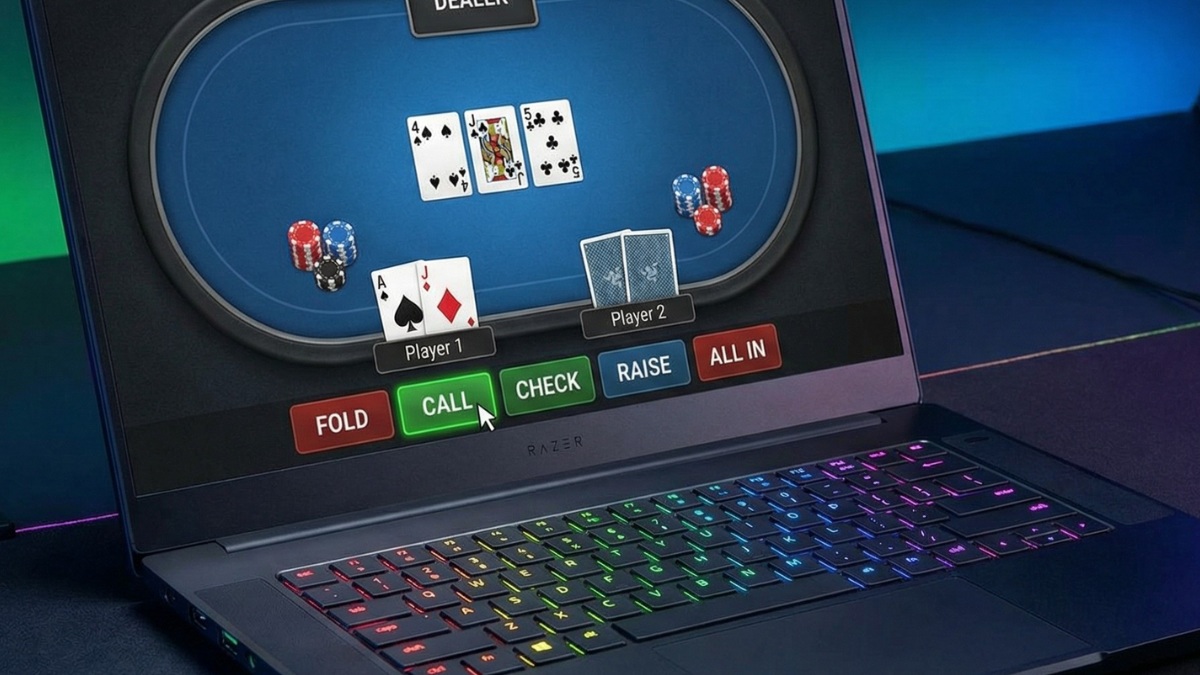
Calling in poker means matching the current bet so the hand can move forward. That sounds basic, but the details matter fast: a call can be a cheap way to realize equity, or a costly way to pay off stronger hands.
The right decision comes from the price you’re getting, your position, and the betting rules in play.
Poker Calls: Definition, Mechanics, and What Counts as a Call
A poker call means matching the current bet so the hand can continue on the same street. If an opponent bets 4,000 chips, calling in poker means putting in 4,000 chips total for that action. Calls show up after a bet, a raise, or a re-raise; the amount you match is always the amount you’re facing at that moment.
Calling only exists when money is already out there. No bet on the table means no call option. That’s where check in poker comes in: checking costs 0 chips and is only legal when action is unopened. Once a player bets, checking disappears and the choices tighten to fold, call, or raise.
Online poker follows the same rules even if the interface makes the options look like simple buttons. The software calculates the call amount automatically, yet the decision is the same: you’re paying a defined price to see the next card or reach showdown. A call can be a flat response to a small bet, or it can be a big commitment facing an all-in; the word stays the same, but the risk changes with the size and the street.
What Is Calling in Poker? Pot Odds
Calling in poker always comes with a price, and that price can be measured without complex math. The idea is simple: compare what you must call to the total pot after you call.
| Bet size (B) | Pot before bet (P) | You call | Pot after call | Break-even equity |
| 1/3 pot | P | 0.33P | 1.66P | 20% |
| 1/2 pot | P | 0.50P | 2.00P | 25% |
| 2/3 pot | P | 0.67P | 2.33P | 29% |
| Pot | P | 1.00P | 3.00P | 33% |
| 150% overbet | P | 1.50P | 4.00P | 38% |
Break-even equity for a poker call is Call ÷ (Pot after you call).
Example: If the pot is 10,000 and an opponent bets 5,000, calling risks 5,000 to win 20,000 after you call, so the break-even equity is 25%. Use the table the same way for any other bet size.
These numbers don’t say you should always call in poker. They show what your hand must beat over the long run. When your realistic winning chance falls below the price offered, calling turns into a negative exchange, no matter how strong the hand feels in isolation.
When Calling Makes Sense Before the Flop
Preflop calling starts with the open size. A raise to 2.2–2.5 big blinds sets a very different price than a raise to 4 big blinds. In a 1,000/2,000 game, the cutoff opens to 5,000, and the big blind has already posted 2,000, so calling costs 3,000 more. Before the call, the pot is 1,000 + 2,000 + 5,000 = 8,000; after the call, it is 11,000, so the break-even equity is about 27% (3,000 ÷ 11,000).
Position changes the EV of that call even when the chip price is identical. Calling on the button keeps last action on later streets, while calling from the small blind plays out of position and forces more poker check vs call on many flops.
Some environments shift sizing. Online rooms with frequent reloads, or leaderboard races, create poker bonuses for players to see flops more often, which often compresses opens and increases multiway pots. That does not improve a marginal call; it increases postflop realization risk when ranges stay wide.
Rule-Driven Check vs Call Poker Edge Cases
Rule quirks can turn a normal poker call into an outcome you didn’t intend. These procedures follow widely used live tournament standards; see TDA Rules 41, 43, and 44 for the governing language.
These are the spots that cause the most confusion in live tournaments and cash games, since the room enforces the rulebook, not the player’s intent.
- Facing 10,000, a raise to 14,000 is less than 50% of the bet size. Under the TDA raise amounts standard (Rule 43), less than 50% is treated as a call unless “raise” is declared first (or the player is all-in). If the raise is 50% or more but still short of a legal minimum raise, the player must complete a full minimum raise.
- A short stack can move all-in for less than a full raise amount. Players can call that amount, but raising rights behind depend on whether the all-in meets the minimum raise threshold, which is evaluated using the same TDA Rule 43 standard for what counts as a full raise.
- Declaring “call” is an acceptable method of calling under TDA methods of calling (Rule 41), and the room will usually treat the declared action as binding even if the chips pushed forward are short. When the bet size is unclear, players are still expected to make intentions clear and follow the action.
- Putting out a single oversized chip without first declaring “raise” is treated as a call when facing a bet or blind under TDA oversized chip betting (Rule 44). To raise with an overchip, “raise” must be declared before the chip hits the table.
These edge cases show why calling is not only a price decision. It’s a rules decision tied to exact sizing and clear action, which is why experienced players slow down when bets get messy.
Calling Without Leaks: Three Numeric Filters That Hold Up
Loose calls in poker usually come from ignoring one of three numeric filters. Keeping all three in view trims mistakes without slowing play.
- Price filter: Match your call to the pot odds. A pot-sized river bet needs about 33% equity; a 150% overbet needs close to 38%. Falling short turns the call into a losing exchange over time.
- Outs filter: Count realistic outs, not hopeful ones. A standard flush draw has 9 outs. With one card to come, the exact chance is 9/46 ≈ 19.6%; players often round this with the “rule of 2” to about 18%–20%. That number doesn’t clear a pot-sized bet on the turn.
- Street filter: Equity shrinks as cards run out. Calls that make sense on the flop often fail on the turn once only one card remains.
Rule-backed tournament example: Many high stakes poker versions and live tournaments use a big blind ante and standard chip denominations, so the price of a poker call can be measured cleanly, street by street. The calculations below use a representative late-stage structure and apply to any tournament using the same betting sizes.
Preflop action builds a 360,000 pot (SB 60,000 + BB 120,000 + BB ante 120,000 + the small blind completing 60,000 more). On the flop, the bettor bets 180,000 into 360,000 (half pot) and gets called. That adds 360,000 to the pot, so the pot going to the turn is 720,000.
On the turn, the bettor fires 480,000 into 720,000. The call now risks 480,000 to win 1.68 million, requiring ~28.6% equity.
Even without a change in opponent or line, the second call demands more equity. Each poker call resets the price because the required call amount changes relative to the pot that has already been built.
Implied Odds and Reverse Implied Odds
Pot odds measure the price right now, but many poker calls are decided by what can happen after you hit or miss. Implied odds means you expect to win additional chips on later streets when you improve.
As an example, the pot is 10,000, and you face a 5,000 bet on the turn. Pot odds say you need 25% equity because you are calling 5,000 to win 20,000 after you call. A flush draw with 9 outs has 9/46 ≈ 19.6% with one card to come, so it is short on raw pot odds.
If you win at showdown with no more betting, your profit is 15,000 (the 20,000 pot minus your 5,000 call). If you miss, you lose 5,000. That makes the baseline EV: 0.196 × 15,000 − 0.804 × 5,000, which is negative. The call becomes break-even if you expect to win about 5,550–5,600 more chips on average when you hit (implied odds), because the shortfall is made up only in the hands where you improve.
Call vs Raise: When Paying the Price Is Not the Best Line
A poker call can meet the pot-odds threshold and still be a weaker choice than raising. The difference is fold equity: a raise can win the pot immediately, often enough to outperform a call that only wins when the hand improves or reaches showdown.
Numeric example: The pot is 10,000, and you face a 5,000 bet. Calling needs 25% equity. If you raise to 15,000 total, the opponent must call 10,000 more to continue, and you also create a chance they fold. When the opponent folds even a modest share of the time, the raise can outperform the call, especially with hands that have outs plus blockers.
As a baseline, if the raise makes the opponent fold often enough that you win the 10,000 pot outright a meaningful share of the time, the raise can beat the call even when both lines have similar showdown equity. The more your hand blocks the opponent’s strongest continues, the more often that fold equity shows up.
The Call Is a Price Tag, Not a Reaction
Calling works best when treated as a transaction, not a reflex. Every call buys access to future cards or showdown at a stated cost, shaped by bet size, position, and the rules in force.
Online poker, live tournaments, and hybrid formats may look different, yet the numbers behind calling stay fixed. Players who respect those numbers don’t need hero reads or dramatic folds.
They wait for prices that line up with their actual chances and let opponents make the expensive mistakes instead.
Need support? Call 1-800-GAMBLER or use local responsible gambling resources.