

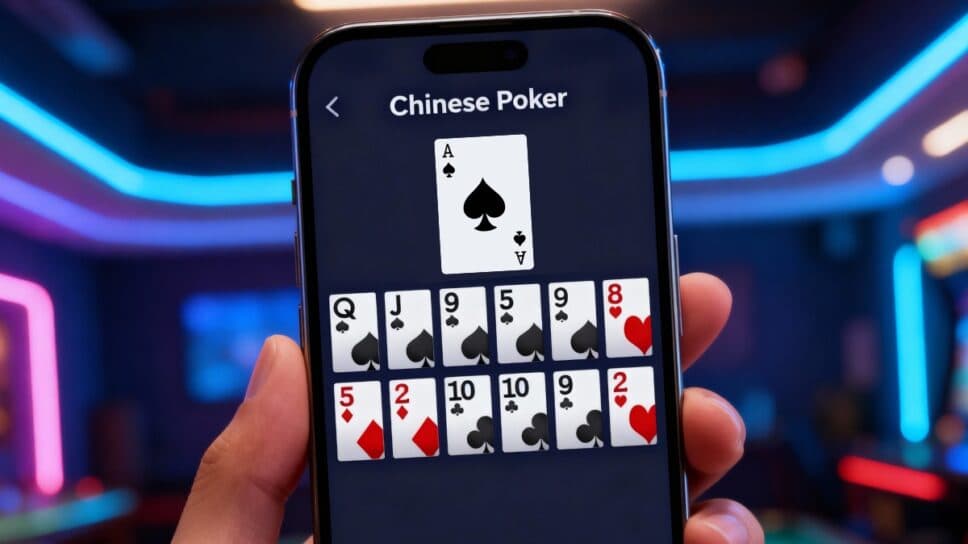
Chinese poker is a strategic card game in which you arrange 13 cards into three separate hands without traditional betting rounds. Unlike Texas Hold'em, the Chinese Poker game emphasizes hand construction and risk management over bluffing. Understanding what Chinese Poker is, how the Chinese Poker scoring system works, and which Chinese Poker combos create winning arrangements separates skilled players from beginners.
What Is Chinese Poker?
Chinese poker, also known as 13 card poker, is a multi-player card game where each player receives 13 cards and arranges them into three distinct hands. The front hand contains three cards, the middle hand includes five cards, and the back hand contains five cards.
The back hand must outrank the middle hand, and the middle hand must outrank the front hand. Violating this rule constitutes a "foul," resulting in the player losing all points for that round.
Chinese Poker Cards and Setup
Chinese Poker uses a standard 52-card deck and supports 2–4 players.
At the beginning of the hand, every player is given 13 face-down cards. Players arrange these cards into the three required hands without seeing opponents' arrangements. Once all players complete their arrangements, the cards are revealed simultaneously for scoring.
The Three Hand Structure
Back Hand (5 cards): The strongest hand, positioned at the back, using standard poker rankings.
Middle Hand (5 cards): Must be weaker than the back hand but stronger than the front hand.
Front Hand (3 cards): The weakest hand, containing only three cards. Front hand rankings apply only to pairs and high cards, since three-card straights and flushes typically don't count under traditional Chinese Poker rules.
Chinese Poker Rules
Chinese Poker rules cover hand construction, valid arrangements, and Chinese Poker scoring. Players learning basics often explore the best poker bonuses to practice Chinese Poker with promo funds.
Basic Play Sequence
- Each player receives 13 cards from a shuffled deck.
- Players arrange their 13 cards into three hands: back (5), middle (5), front (3).
- The back hand must be the strongest, the middle second, and the front weakest.
- Players reveal arrangements simultaneously.
- Hands are compared head-to-head.
- Points are awarded based on wins, royalties, and combinations.
The Foul Rule
A foul occurs when the hands are not arranged in descending order of strength. If the middle hand is stronger than the back hand, or if the front hand is stronger than the middle hand, the arrangement fouls.
Players who foul lose automatically to all opponents for that round, typically forfeiting six points per opponent.
Hand Comparison Method
Each player's front hand is compared against every opponent's front hand. The same process is repeated for the middle and back hands. A player who wins two out of three hands wins one unit. Winning all three hands (a "scoop") typically awards a total of three units.
Chinese Poker Hands and Rankings
Chinese Poker hands follow standard poker hand rankings for the five-card middle and back hands. The three-card front hand uses modified rankings since certain combinations are impossible with only three cards.
Five-Card Hand Rankings (Back and Middle)
Standard poker rankings apply, from highest to lowest:
Hand Rank Description | Royal Flush A-K-Q-J-10, all of the same suit | Straight Flush Five consecutive cards of the same suit | Four of a Kind Four cards of the same rank | Full House Three of a kind combined with a pair | Flush Five cards of the same suit, not in sequence | Straight Five consecutive cards of mixed suits | Three of a Kind Three cards of the same rank | Two Pair Two separate pairs | One Pair Two cards of the same rank | High Card No matching cards or sequence |
Three-Card Front Hand Rankings
Front-hand rankings are limited due to the three-card structure:
- Three of a Kind: Three cards of the same rank
- Pair: Two cards of the same rank
- High Card: No matching cards
Most Chinese Poker rules do not recognize three-card straights or flushes in the front hand.
These hand-ranking conventions and front-hand limitations are consistent with traditional Chinese Poker rules as documented by Pagat, a widely cited reference for international card game standards.
Chinese Poker Suit Order
When comparing hands of identical rank, the Chinese Poker suit order determines the winner in some variations. The standard suit hierarchy from highest to lowest is:
- Spades (♠)
- Hearts (♥)
- Diamonds (♦)
- Clubs (♣)
Many games instead treat identical hands as a push; suit order varies by ruleset.
Chinese Poker Scoring
Chinese Poker scoring systems vary between standard point-based scoring and royalty bonuses for exceptionally strong hands.
Standard Point Scoring
The basic scoring framework awards one point for each hand won. Winning two out of three hands earns one point total. Winning all three hands (scooping) earns three points total.
Example: Player A vs. Player B.
- Front: Player A wins (+1)
- Middle: Player B wins (-1)
- Back: Player A wins (+1)
Player A wins two out of three, earning +1 point.
If Player A wins all three hands, they would score +3 points.
Royalty Bonuses
Royalties are bonus points for exceptionally strong hands. These apply regardless of whether the hand wins.
Front Hand Royalties:
- Pair of 6s through Aces: +1 to +9
- Three of a Kind: +10 to +50
Middle Hand Royalties:
- Three of a Kind: +2
- Straight: +4
- Flush: +8
- Full House: +12
- Four of a Kind: +20
- Straight Flush: +30
- Royal Flush: +50
Back Hand Royalties:
- Straight: +2
- Flush: +4
- Full House: +6
- Four of a Kind: +10
- Straight Flush: +15
- Royal Flush: +25
Royalty values vary across different variants. Confirm royalty schedules before playing for stakes.
Fantasyland
Fantasyland is an advanced feature in Open-Face Chinese Poker, but sometimes appears in traditional formats. A player who achieves a pair of Queens or better in the front hand without fouling qualifies for Fantasyland on the next hand.
In Fantasyland, the player receives all 13 cards at once instead of drawing them sequentially, providing a significant advantage.
How to Play Chinese Poker
Learning how to play Chinese Poker requires understanding hand construction principles, common strategic errors, and optimal card placement.
Setting Your Hands
The arrangement process determines outcomes more than luck. Players must balance creating strong hands against avoiding fouls.
Back Hand Priority: Place the strongest cards here first, as the back hand must be the strongest.
Middle Hand Balance: The middle hand requires careful balancing between back and front strength.
Front Hand Considerations: The front hand often determines whether an arrangement is foul. Players frequently place the weakest cards here, but front-hand royalties can incentivize risk-taking.
Common Strategic Principles
Avoid Fouls: The most critical rule. A foul loses all points for that round.
Maximize Royalties: Calculate whether pursuing royalties justifies weakening other hands.
Understand Opponents: Observe opponents' risk tolerance and hand-setting patterns.
Calculate Probabilities: Experienced players estimate the likelihood that opponents hold stronger hands in each position.
Players developing strategic depth often reference comprehensive resources, such as a poker guide to winning, that cover decision-making frameworks applicable across poker variants.
Chinese Poker Combos and Advanced Strategy
Chinese Poker combos refer to specific card arrangements that maximize point value while maintaining a valid hand order.
High-Percentage Combos
Set-Over-Set: Placing three of a kind in the middle hand (earning royalty) while maintaining a full house or better in the back.
Flush Draw Split: When holding six or seven cards of one suit, determining whether to place five in the back or split them.
Straight Construction: Deciding which consecutive cards belong in the back versus the middle hand.
Risk-Reward Calculations
Aggressive players pursue higher royalties by weakening their comparison strength. Conservative players prioritize winning hand comparisons.
Foul Risk vs. Royalty Upside
In practice, aggressively chasing front-hand royalties sharply increases the risk of foul. Hand-history analysis from high-volume Open-Face and traditional Chinese Poker games shows that players prioritizing front-hand three-of-a-kind or high-pair royalties foul approximately 20–30% more often than those using conservative back-hand–first constructions.
While front-hand royalties can produce large point swings, expected value improves only when the middle and back hands remain strong enough to avoid automatic fouls. As a result, experienced players selectively pursue front-hand royalties only when the remaining card pool still supports structurally sound middle and back hands.
Example: A player holds A♠ A♥ A♦ K♠ K♥ Q♣ Q♦ J♠ 10♠ 9♠ 8♠ 7♣ 5♦.
Conservative: Back: A♠ A♥ K♠ K♥ Q♣ / Middle: J♠ 10♠ 9♠ 8♠ 7♣ / Front: A♦ Q♦ 5♦
Aggressive: Back: J♠ 10♠ 9♠ 8♠ 7♣ / Middle: K♠ K♥ Q♣ Q♦ 5♦ / Front: A♠ A♥ A♦ (massive front royalty)
The aggressive approach yields substantial front-end royalties but entails greater midstream losses.
Variants of Chinese Poker
Several Chinese Poker variants modify the rules, scoring, or card distribution. Players exploring format differences often compare offerings at crypto poker sites where diverse Chinese Poker versions attract strategic players.
Open-Face Chinese Poker (OFC)
In OFC, players receive five cards initially and place them face-up in any of the three hands. Players then receive one card at a time and place each immediately. This open-information format adds psychological elements and real-time decision-making.
OFC includes Fantasyland rules and typically uses more aggressive royalty schedules.
Pineapple Open-Face Chinese Poker
Pineapple OFC deals three cards at a time instead of one, and players place two while discarding one. This variant increases strategic complexity.
Playing Chinese Poker Online
Chinese Poker appears on various online poker platforms.
Online vs. Live Play
Online play offers automatic foul checks, instant royalty scoring, and multi-tabling. Live play requires manual scoring and rewards observation and table awareness.
Bankroll Management for Chinese Poker
Chinese Poker’s scoring system creates higher variance than limit poker due to royalty bonuses, though swings remain lower than no-limit formats. A conservative approach is to maintain 50–100 buy-ins.
Common Chinese Poker Mistakes
Understanding frequent errors accelerates improvement.
Front Hand Over-Ambition
New players often place too-strong cards in the front hand, pursuing royalties, then foul. Conservative front-hand construction prevents this error.
Ignoring Middle Hand Royalties
While front-hand royalties are highest, middle-hand royalties provide excellent value. A middle hand flush earns substantial points without risking fouls. Players refining these strategies often compare online poker platforms, noting that Chinese Poker variants help develop middle-hand construction skills.
Failing to Calculate Opponent Range
Experienced players consider what hands opponents likely hold based on their behavior.
Playing Too Conservatively
While avoiding fouls is critical, never pursuing royalties when opportunities arise costs long-term value.
Mastering 13 Card Poker Strategy
Chinese Poker rewards disciplined hand construction, probability awareness, and controlled risk-taking rather than betting aggression. Players who consistently avoid fouls, understand Chinese Poker scoring, and selectively pursue royalties gain long-term advantages over opponents chasing short-term point swings.
Strong play comes from balancing back-hand strength with middle-hand stability while recognizing when front-hand royalty opportunities justify added risk. Over time, mastering Chinese Poker combos relies more on pattern recognition than memorization.
Please play responsibly. 18+, T&Cs apply.


