

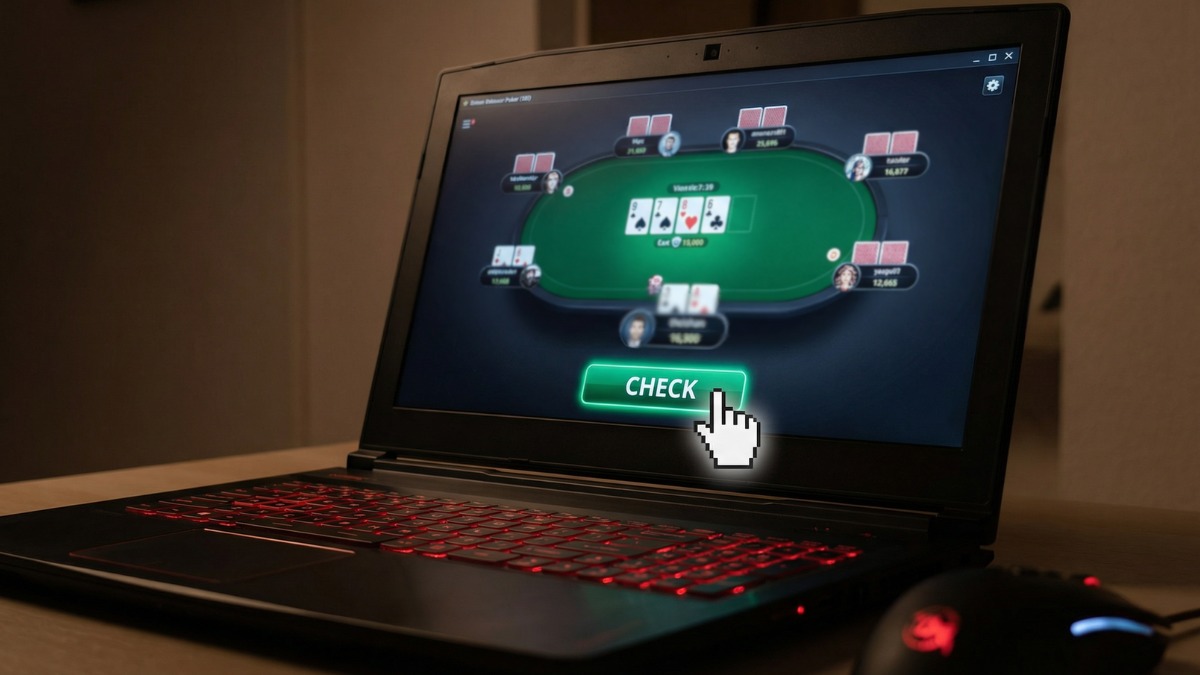
What does “check” mean in poker? A check in poker means passing the action without betting, while keeping the hand active. It is legal only when no wager exists in the current betting round.
Once someone bets, checking is off the table, and the only options are call, raise, or fold. In flop games like Hold’em and Omaha, checks are common postflop; preflop, the big blind may check only when the action is unraised.
What Does Check Mean in Poker and When Is It Legal?
The rule is simple: check is available only when facing no bet; once a bet is made, you must call, raise, or fold.
From a rules perspective, a check passes action without adding chips. It keeps the hand active and signals that the player is not opening the betting on that street. In flop-based games like Texas Hold’em and Omaha, checking commonly appears after the flop, turn, or river when the first player to act decides not to open the betting.
Preflop works differently because blinds are live bets. Most players must call, raise, or fold, but the big blind may check when the action is unraised.
Tournament rules treat check as a valid action only when facing no bet, and they recognize a clear verbal “check” or a table tap as the same action.
Example: big blind check option (unraised pot)
In a $1/$2 no-limit Hold’em game, action folds to the button, who calls $2. The small blind completes for $1. The big blind already has $2 posted, so they may check and see a flop. If the button had raised, the big blind could not check and would have to call, raise, or fold.
When Checking Is Allowed, and When It Isn’t
Checking in poker depends entirely on the betting status of the current round. The rule is consistent across formats, though the situations vary.
Checking is allowed when:
- No player has bet in the current betting round.
- Action reaches you after all prior players checked.
- You are first to act on a postflop street and decline to open betting.
Checking is not allowed when:
- You are facing a bet or raise.
- You are facing a live wager preflop (blinds), except the big blind may check if action is unraised.
- Action is reopened by a raise; you must respond with call, raise, or fold.
In practical terms, this explains a common point of confusion. In no-limit Texas Hold’em, the small blind and big blind are forced bets, so the first voluntary action preflop always involves matching or increasing that amount, or releasing the hand.
Checking only enters the picture once a betting round starts with no chips committed. Tournament Directors Association rules updated in October 2024 reinforce this distinction, defining a check as valid only when no wager is pending.
Live Table Communication: Verbal Action, Table Tap, and Dealer Control
At live tables, a poker check must be communicated clearly. The two accepted signals are a verbal declaration of “check” or a single, deliberate tap on the felt. Tournament rules published in 2024 state that tapping the table equals a check when no bet is present, removing uncertainty for dealers and opponents.
Problems arise when gestures are rushed or out of turn. In tournament settings, clear actions and standard gestures control, and ambiguous motions can be ruled as the first clear action the dealer observes. An out-of-turn table tap may be held as a check if the action checks to that player with no bet in between.
This emphasis on clarity applies across formats. Online poker sites replace gestures with buttons, but the rule behind the action does not change. A check still passes action only when no bet exists, and once confirmed, it cannot be withdrawn. Understanding how checks are recognized helps players avoid accidental commitments that alter the course of a hand.
Tournament rules standardize these signals, while cash games follow house rules; either way, a clear verbal declaration or a clean table tap avoids disputes.
Common Check Lines Players See in Real Hands
Checking often shows up as part of familiar action patterns rather than a standalone decision. These labels describe how the hand unfolded, not a separate rule.
A check-through happens when every active player checks, and the betting round ends with no chips added. In a nine-handed game, that means up to eight consecutive checks after the first player acts. A check-call describes a player who checks, then calls a bet once another player opens the action. A check-raise starts with a check, followed by a raise after an opponent bets, reopening action at a higher amount.
Players also use short phrases tied to action flow. “Checked to” means the players before you checked, so the decision to bet or check is now yours. “Check it down” is informal table talk; it has no special status and does not remove anyone’s right to bet.
Common river pattern: On the river, a player checks, the next player bets about 40% of the pot, and the first player responds with a check-raise to around 2.5× the bet. The key rule point is unchanged: the initial check is legal only because no bet existed yet on that street.
Comparison Table: How Checking Works Across Popular Poker Variants
The rule behind a check stays consistent, though when it appears depends on the game format. The table below compares how checking functions across widely played variants.
| Game Variant | When Checking Is Allowed | Key Notes |
| Texas Hold’em | Postflop when no bet exists | Player left of the button acts first; big blind may check preflop if unraised; blinds are live bets |
| Omaha | Postflop when action is unopened | Same checking rules as Hold’em; big blind may check preflop if unraised |
| Short Deck | When no bet exists in the betting round | First active player acts; blind/ante structure varies by table |
| Seven-Card Stud | After the bring-in is matched or completed | First active player acts; bring-in is forced action |
| Draw Poker | When no bet exists, including after the draw | Checks commonly appear after the draw phase |
Table note: Sources: WSOP 2025 Official Tournament Rules (PDF); Tournament Directors Association Poker Rules (Oct 9, 2024).
How Checking Changes the Betting Flow
A check doesn’t add chips, yet it still changes how the betting round develops. When the first player checks, the next player gets the choice to open betting or pass the decision along with another check. That single moment affects the rest of the street because a later bet forces every remaining player to respond in order, which can widen the gap between a small pot and a large one.
A check only applies to the current betting round. Once the next card is dealt (turn or river), the betting status resets and checking becomes available again for the first player to act, unless a bet is made.
Three patterns show up again and again. A street can check through, meaning everyone checks, and the round ends with 0 chips added. A player can check and then face a bet, which immediately removes the option to check again and leaves only call, raise, or fold.
The third is the check-raise line, where a player checks, an opponent bets, and the original checker raises, reopening action at a higher amount. None of these labels are special rules; they’re just shorthand for the sequence created once the first check passes action forward.
Online poker formats move faster because the interface can preselect actions. The rule does not change: a check is available only when no bet exists, and once action is confirmed, it cannot be taken back.
Mistakes That Turn a Check Into Trouble
Most checking errors come from timing and communication, not from misunderstanding the definition.
- Trying to check into a bet: once a wager exists, “check” is not a legal response; the only options are call, raise, or fold.
- Acting out of turn: a premature table tap can bind a player to a check if no bet appears before action returns.
- Unclear live gestures: tapping chips, hovering a hand, or mixing words with movement can cause the dealer to lock in the first clear action seen.
- Online misclicks and preselect traps: a preselected “check” can fire instantly when action reaches the player, and undo options can be limited.
- Mixing up bonus language: poker bonuses are usually tied to raked-hand definitions or hand-count targets, not betting actions; checking itself doesn’t change eligibility, yet fast-fold formats and speed settings can change how quickly hands accumulate under the terms.
The Smallest Action With the Biggest Clarity Requirement
A check is simple in definition and strict in practice. It keeps a hand alive without putting chips in, yet it locks in an action that can’t be taken back once the next player moves. That’s why clean timing and clear communication matter so much, especially in live rooms where gestures get interpreted fast and in online games where a single click confirms intent. Treat the check as a precise choice, not a pause, and the betting round stays clean.
Need help? Call 1-800-GAMBLER or visit your state’s problem gambling resource.