

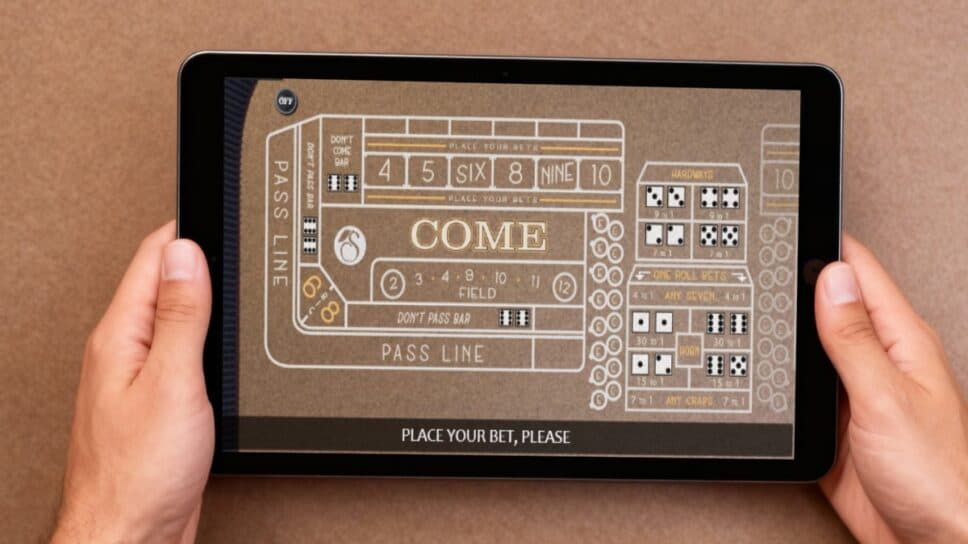
The best craps bets are the ones that pair simple rules with a house edge that sits near the 1–2 percent range over time.
That list usually starts with pass line and come bets, backed up by free odds, then place bets on 6 and 8.
Ranking The Best Craps Bets By House Edge
Ranking house edges gives a clear picture of which wagers sit near the top of the craps chart and which ones erode a bankroll fastest—and it’s applicable for standard tables and online casinos.
On most standard layouts, don’t pass and don’t come shave the edge slightly below pass and come, although many players still prefer betting with the shooter.
The table below ranks core options in ascending house edge, from the best bet in craps to worst. The figures assume standard Las Vegas payouts, with edges derived from the usual 36 dice combinations.
Bet Type Typical Payout House Edge % (per bet) Notes | Free Odds (Pass/Come) True odds (2:1, 3:2, 6:5 by point) 0.00 Extra stake behind line bets after point, no edge | Lay Odds (Don't Pass/Come) True odds (1:2, 2:3, 5:6 by point) 0.00 Extra stake behind don't bets, also no edge | Don't Pass 1:1 1.36 Bets against the shooter; wins when 7 arrives first | Don't Come 1:1 1.36 Mirror of Don't Pass on later rolls | Pass Line 1:1 1.41 Backs the shooter from come-out roll through point | Come 1:1 1.41 Same as Pass Line, entered after a point is set | Place 6 or 8 7:6 1.52 6 or 8 must roll before 7 | Place 5 or 9 7:5 4.00 More expensive than placing 6/8 | Buy 4 or 10 (5% commission) 2:1 ~4.76 Commission-adjusted, often better than placing | Field (2 pays 2:1) Even on most hits; 2:1 on 2 and 12 5.56 Single-roll wager; check layout text for 12 payout | Place 4 or 10 9:5 6.67 Only three winning combinations on each number | Hard 6 or 8 9:1 9.09 Wins on doubles only; loses on any 7 or easy total | Big 6 / Big 8 1:1 9.09 Same targets as place 6/8 but at a worse price | Hard 4 or 10 7:1 11.11 Fewer combinations and a higher edge | Any Craps (2, 3, 12) 7:1 11.11 One-roll shot that drains bankrolls quickly | Any 7 4:1 16.67 Single-roll prop with one of the steepest edges |
Source: House edge and payout data drawn from Wizard of Odds and the Maryland State Lottery and Gaming Control Agency, Craps Standard Rules (MLGCA Version 1.5, June 2024).
Pass Line And Come Bets: The Best Bets to Make in Craps
Pass line and come wagers track the same two-phase structure of a round.
On the come-out roll, a pass line bet wins on 7 or 11, loses on 2, 3, or 12, and sets a point on 4, 5, 6, 8, 9, or 10. Once a point is on, the bet wins if that number returns before the next 7. Come bets copy this pattern from the moment they land, creating new personal points as the dice move.
From a numbers angle, these are the best bets for craps, and carry a modest house edge of about 1.41 percent on standard Las Vegas odds—so every 100 dollars cycled through pass or come expects around 1.41 dollars in theoretical loss over long samples. That figure compares favorably with many table games and sharply undercuts most proposition wagers.
Don’t pass and don’t come mirror pass and come in reverse. On standard rules, the house edge drops to about 1.36 percent on each flat bet, slightly lower than the 1.41 percent on line bets with the shooter. A player cycling 100 dollars through these wagers gives up roughly 1.36 dollars in expected loss, although table culture often leans toward backing the shooter instead.
Odds Behind The Pass Line: Supporting The Best Odds In Craps
Odds bets sit behind pass line and come wagers once a point is established, and they carry no built-in house edge. The casino pays them at true mathematical odds, such as 2:1 on 4 and 10, 3:2 on 5 and 9, or 6:5 on 6 and 8.
When a safe craps table offers double odds, a player staking 10 dollars on the pass line can place up to 20 dollars in odds; the combined edge on that 30 dollar position drops to roughly 0.61 percent, calculated across the whole wager.
Higher limits like 3x–4x–5x odds push the blended edge lower again, often into the 0.4 percent band for the total stake. On a 10 dollar table with 3–4–5x odds taken in full, running 100 resolved rounds puts roughly 3 to 4 dollars in expected loss on the combined position, based on that blended edge of about 0.4 percent.
Use odds only once a point is set and watch posted signs or info panels, since craps’ best odds can vary and directly shape the overall edge on that table.
The Best Numbers To Bet On Craps
Place bets on 6 and 8 sit in a useful middle ground between simple line bets and sharper, high-volatility wagers. On a standard layout with usual payouts, a placed 6 or 8 wins if that number rolls before the next 7.
Each of those numbers has five winning combinations against six ways to make a 7, so the wager resolves often enough to keep the action moving.
Many players still prefer line bets because they pair cleanly with odds instead of spreading extra units across more numbers.
Three habits help finding the best numbers:
- Compare place and buy options: On 6 and 8, place bets usually offer better value than buy bets with commission, since standard 7:6 payouts already mirror fair pricing closely.
- Size units with the table minimum: Many players mirror the minimum on each number, such as 12 dollars on 6 and 12 dollars on 8 at a 10 dollar table, so wins and losses stay easy to track.
- Limit how many numbers are active: Spreading across too many place bets raises total exposure per roll. Keeping action on 6 and 8 alone can keep variance lower than covering the full grid.
Safest Bet In Craps, And Where That Idea Breaks Down At Real Tables
Pass line and come bets, backed with full odds, sit close to the low end for long-term expectation, yet the casino still holds an advantage on the flat portion.
At 1.41 percent edge, cycling 1,000 dollars through pass line bets expects about 14.10 dollars in theoretical loss over time, even if short runs land ahead.
Over 50 resolved rounds at a 10 dollar pass line with full 3–4–5x odds behind, the blended edge of about 0.4 percent translates into roughly 8 dollars in expected loss, while staking 10 dollars on Any 7 instead on each roll would carry more than 80 dollars in expected loss across the same sample.
So-called “safe” bets are really lower-edge options with smoother variance, not guarantees. Focusing on pass line, come, moderate odds, and place bets on 6 and 8 trims statistical disadvantage compared with the center of the layout, but the house edge never drops below zero on the overall mix of wagers.
Bets To Treat With Caution: Field, Hardways, And Center-Table Props
Field rolls, hardways, and one-roll propositions all trade frequent small losses for the chance at sharp payouts, which can drain a bankroll quickly when the dice lean cold.
- Field Bets On A Single Roll: A standard field bet covers several totals for one roll, with even-money wins on most hits and boosted returns on 2 or 12. With a house edge around 5.56 percent on common schedules, repeated field action erodes chips faster than low-edge line or place bets.
- Hardways On Doubles Only: Hard 4, 6, 8, and 10 pay premium odds because they need exact doubles such as 3–3 for hard 6; any soft version of the number or any 7 loses. Edges in the 9–11 percent range push these into the occasional side-bet category rather than a main strategy.
- Center-Table One-Roll Propositions: Center-table propositions like Any 7 or Any Craps settle on every roll and often carry house edges between about 11 and 16.67 percent. The table above shows how steep that cost is compared with pass, come, and place 6/8.
What Is the Best Bet in Craps When Playing Online?
Online craps and live tables use the same basic pay tables, so the math behind low-edge wagers stays consistent.
Regulated US online platforms publish rules in game info panels, including house edge data and odds limits, while casino floors use layout text and posted rules to show whether a table offers double odds, 3x–4x–5x odds, or higher. Many online craps games mirror 3x–4x–5x odds on pass and come, although some state-licensed titles cap odds at 2x, which pushes more of the edge back onto the flat bet.
On online craps sites, state gaming commissions and independent labs such as GLI or state gaming labs review the random number generators before games go live, so posted pay tables and edges match the written rules.
Keeping Your Roll Grounded In Low-Edge Choices
Fast chip movement at a busy table can distract from the underlying edge on each wager.
Focusing on low-edge wagers keeps the math closer to even, which gives your bankroll more room to ride out the natural ups and downs of the dice. That approach turns every bet choice into a small risk-management call instead of a pure hunch.
Short sessions can still swing hard in either direction, so staking amounts that fit your budget matters as much as picking the right part of the layout. Table limits, odds caps, and your own comfort level with swings all shape how long a buy-in lasts.
Treat each wager as part of a plan and decide before reaching for chips if it sits in your core lineup or in the “once in a while” column.
Gamble responsibly, and never risk money you cannot lose.


